
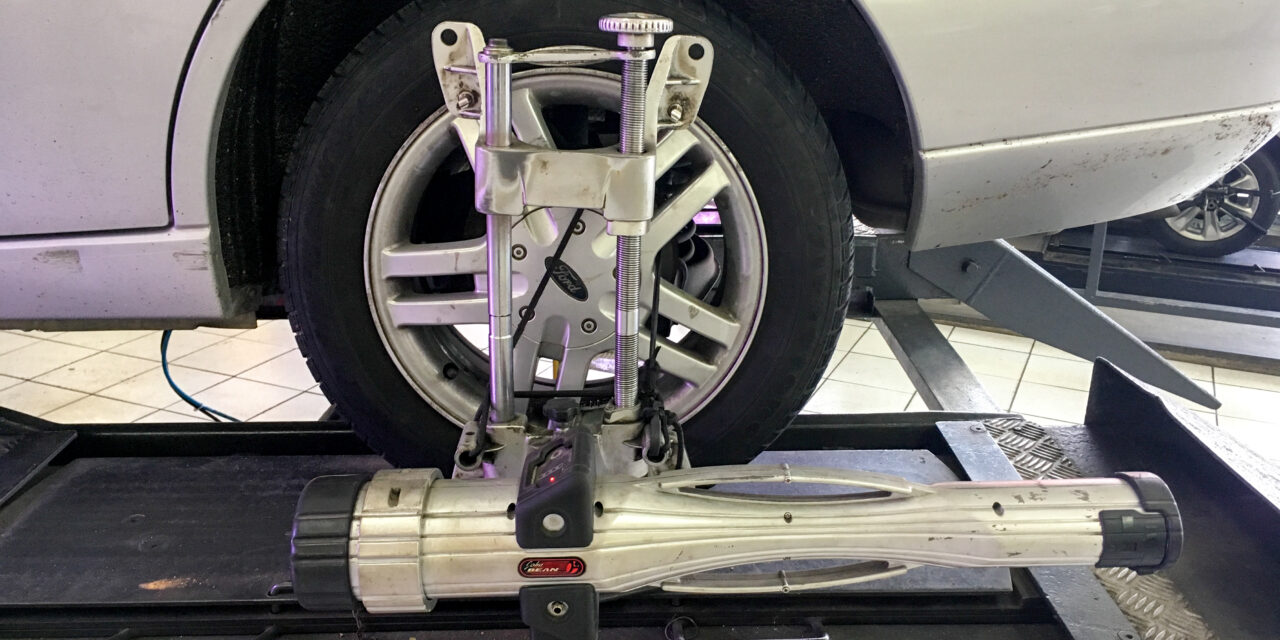
If you have ever been told your car needs tracking when you asked about wheel alignment, you are not imagining the mixed messages. In UK garage talk, the terms are often used interchangeably, but they are not quite the same thing.
The simple version is this: tracking usually means adjusting toe, while wheel alignment is the wider check of your car’s steering and suspension geometry, including toe, camber and sometimes caster.
That difference matters, because some cars only need a quick toe adjustment after hitting a pothole or fitting tyres, while others need a proper four-wheel alignment check to stop uneven tyre wear, steering pull or a crooked steering wheel.
Quick answer
- Tracking usually refers to the direction the wheels point relative to each other, mainly the toe setting.
- Wheel alignment is the broader geometry check, which can include toe, camber and caster depending on the car and the equipment.
- Many UK garages still say tracking when they really mean alignment, so it is worth asking exactly what will be measured and adjusted before you pay.
What is tracking?
Tracking is the old-school term most drivers know. In practice, it normally means checking whether the wheels point slightly inwards, outwards or straight ahead when viewed from above. That setting is called toe.
If the toe is out of spec, the car might:
- pull slightly left or right
- feel nervous on the motorway
- scrub the edges off the tyres
- sit with the steering wheel off-centre even when driving straight
On many older jobs, a garage would put the car on a tracking rig and adjust the front toe only. That is why plenty of drivers still think tracking and alignment are exactly the same service.
What is wheel alignment?
Wheel alignment is the broader geometry check. A proper alignment machine compares the wheel angles with the manufacturer’s target settings and shows what is in or out of tolerance.
Depending on the vehicle, alignment can include:
Toe
This is the one most people already know as tracking. It is the direction the wheels point relative to each other and the centreline of the car. Toe that is even slightly wrong can chew through tyres surprisingly quickly.
Camber
Camber is the inward or outward lean of the wheel when viewed from the front of the car. Too much negative or positive camber can wear one shoulder of the tyre faster than the rest.
Caster
Caster is the steering axis angle when viewed from the side. You do not need to memorise the theory, but it affects straight-line stability, steering self-centre feel and how the car behaves after a turn.
Not every car allows every angle to be adjusted. On some models, the machine can measure camber and caster but only toe is adjustable without extra parts or repairs.
So are wheel alignment and tracking the same?
Not strictly, no. Tracking is usually one part of wheel alignment.
The confusion comes from the fact that a lot of tyre centres and garages use the words loosely. One place may advertise tracking but actually perform a modern four-wheel geometry check. Another may advertise wheel alignment but only adjust front toe.
That is why the best question is not, "Do you do tracking?" It is:
"Are you checking front toe only, or doing a full four-wheel alignment and printout?"
When do you need tracking only, and when do you need full alignment?
A basic toe or tracking adjustment may be enough if:
- you have had a minor knock with no obvious suspension damage
- the steering wheel is slightly off-centre
- you have fitted tyres and the garage spots a small toe error
- the car is otherwise driving normally
A full four-wheel alignment check is the better choice if:
- the car pulls to one side
- the steering wheel is crooked on a straight road
- you have uneven tyre wear, especially inner-edge wear
- you have hit a bad pothole or kerb
- suspension or steering parts have been replaced
- the rear tyres are wearing oddly
- the car feels unsettled or does not track straight
If you are seeing unusual tyre wear, it is worth remembering that geometry problems can show up long before an MOT fail. We have already covered how tyre condition can become a test-day issue in our guide to Tesla Model Y tyre wear and MOT failures.
Why garages use the words differently
Part of it is habit. Tracking is the older, familiar term, so garages keep using it because drivers recognise it. Part of it is marketing, because tracking sounds simple and cheap.
But modern cars have more complex suspension geometry, and a front-toe-only adjustment is not always enough. If the rear axle is out, or if a worn component is changing the wheel position under load, chasing the front toe alone may not solve the real problem.
That is also why alignment should not be used as a substitute for fixing worn parts. If you have knocks, looseness or suspension wear, sort that first. Problems like worn bushes, links or springs can throw the geometry off again very quickly.
What causes alignment or tracking to go out?
Common UK causes include:
- potholes
- clipping kerbs while parking
- speed bumps taken too hard
- worn suspension or steering components
- replacing parts such as track rod ends, wishbones or springs
- tyre changes where poor wear reveals an existing geometry issue
British roads do not exactly make life easy for suspension, so it is no surprise alignment work is a routine maintenance job rather than something exotic.
What are the signs your car needs alignment?
Watch for these symptoms:
- the steering wheel sits off-centre
- the car drifts or pulls on a flat road
- one tyre edge is wearing much faster than the other
- the car feels twitchy at speed
- fuel economy seems worse with no obvious reason
- new tyres start wearing unevenly far too soon
A pull can also come from tyre pressures, tyre construction differences or a sticking brake, so alignment is not the only possible cause. Still, it is one of the first things worth checking.
Does wheel alignment affect MOT results?
There is no separate MOT item marked wheel alignment. A car does not usually fail simply because the geometry numbers are slightly out.
However, the results of poor alignment can contribute to MOT trouble. Excessive or uneven tyre wear, damaged suspension parts, steering faults and related issues can all become testable problems. The government MOT guidance makes clear that tyres, wheels, steering and suspension are all inspected during the test.
2-wheel vs 4-wheel alignment: which should you choose?
For most modern cars, 4-wheel alignment is the safer default if you are chasing a handling or tyre-wear complaint. Even if only the front is adjustable, checking the rear tells you whether the car is pointing straight as a whole.
A 2-wheel check can be fine on simpler cars or when you know the issue is limited to the front toe. But if the rear geometry is out, a front-only setup can leave the steering wheel straight while the car still crab-walks slightly down the road.
How much does wheel alignment cost in the UK?
Prices vary by car and by retailer, but the gap between tracking and full alignment is usually not huge. As checked on 18 April 2026, Halfords listed 2-wheel alignment at £59.99 and 4-wheel alignment at £94.99, while Kwik Fit advertised wheel alignment services starting from £39.95 and 4-wheel alignment from £69.95.
Those are retailer examples rather than a universal tariff, and prices can change, but they give a useful ballpark. On that basis, paying a bit more for a proper four-wheel check often makes sense if you are already seeing uneven tyre wear or steering problems.
What to ask before you book
To avoid paying for the wrong service, ask the garage:
- Is this front tracking only, or a full four-wheel alignment check?
- Will you give me a before-and-after printout?
- Which angles can actually be adjusted on my car?
- If something is out of spec but not adjustable, what is the likely cause?
- Are there any worn suspension or steering parts that need fixing first?
Those answers will tell you far more than the label on the price list.
The bottom line
If you want the shortest possible answer, here it is: tracking is usually toe, while wheel alignment is the bigger geometry picture.
In everyday conversation, garages may blur the terms. As a driver, the smart move is to focus on what is being checked, what is being adjusted and whether the shop is measuring all four wheels. That is the difference between a quick toe tweak and a proper diagnosis of why your car is wearing tyres or wandering down the road.
If your steering wheel is crooked, the car is pulling, or your tyres are scrubbing away on one edge, a full alignment check is usually money better spent than guessing.



Trackbacks/Pingbacks