
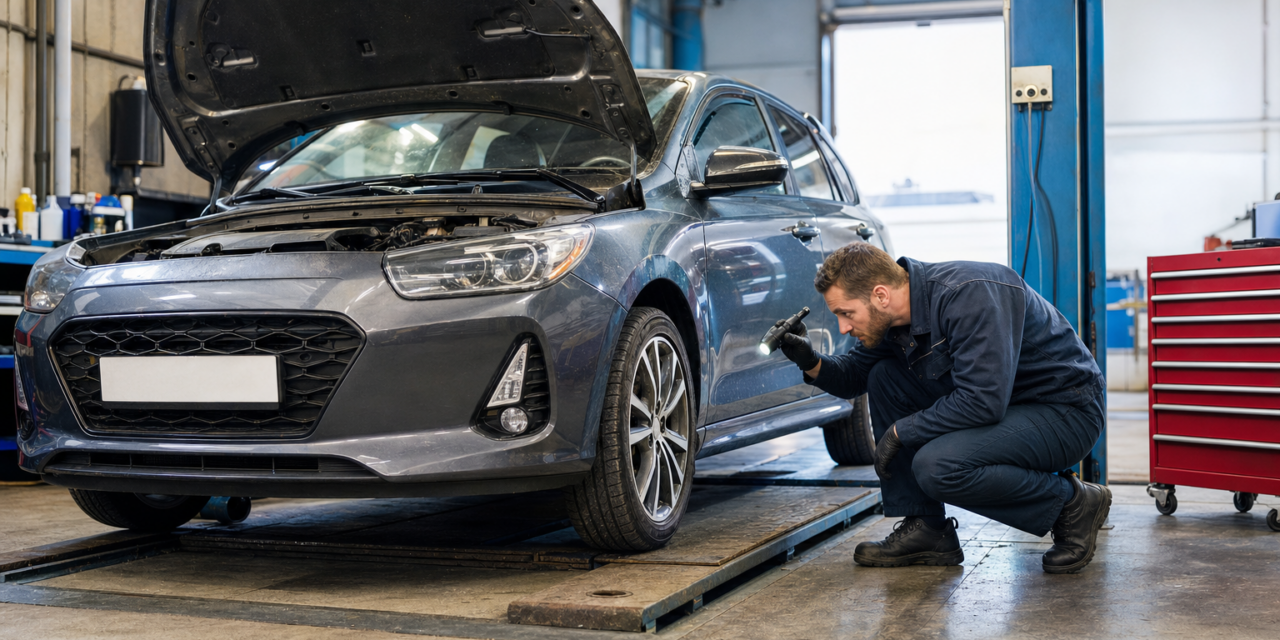
Quick answer: many common MOT failures cost less than £150 to fix, but brake, suspension, emissions and corrosion faults can quickly become several hundred pounds. The cheapest MOT failure is usually the one you spot before the test: bulbs, wipers, tyres, warning lights and obvious leaks are all worth checking early.
This guide brings together the most common UK MOT repair jobs, rough cost ranges and links to deeper Motoring Mojo guides for specific faults. Prices vary by car, parts quality, labour rate and how badly the fault has developed, so use these figures as a planning guide rather than a garage quote.
Common MOT failure repair costs in the UK
| MOT fault | Typical repair cost | How urgent is it? |
|---|---|---|
| Bulb or number plate light | £5–£40 | Usually quick, but still a fail if required lights do not work |
| Wiper blade | £10–£35 per blade | Easy pre-test fix |
| Tyre below legal limit | £55–£160+ per tyre | Urgent; illegal and unsafe if below limit |
| Brake pads | £90–£220 per axle | Urgent if worn to MOT failure level |
| Brake discs and pads | £180–£450 per axle | Urgent if braking performance is affected |
| Brake pipe corrosion | £120–£500+ | Often urgent; cost depends on access and pipe routing |
| Suspension arm or bush | £120–£350 per side | Important; can affect handling and tyre wear |
| Ball joint | £90–£250 | Important; dangerous if severe |
| Coil spring | £150–£350 per side | Important; broken springs are common MOT failures |
| Shock absorber leak | £140–£350 per side | Important; often best replaced in pairs |
| Exhaust leak | £80–£400+ | Depends on location and whether a section or full system is needed |
| Emissions or lambda fault | £80–£900+ | Variable; diagnosis matters before replacing parts |
| Catalytic converter | £300–£1,200+ | Potentially expensive; confirm the cause first |
| ABS, airbag or stability warning light | £60–£600+ | Needs diagnosis; do not just clear the code |
| Sharp bodywork edge | £30–£300+ | Can be simple if minor, costly if corrosion/body repair is needed |
What happens if your car fails an MOT?
The MOT inspection separates defects into minor, major and dangerous categories. A car can pass with minor defects, but major and dangerous defects mean a fail. Dangerous defects should not be ignored or driven around as if they are normal advisories.
DVSA’s MOT manual says major defects may affect safety, the environment or other road users, while dangerous defects present a direct and immediate risk. That distinction matters when deciding whether to drive, repair on site or arrange recovery.
Cheap MOT fixes you should check before test day
Before paying for an MOT, spend 20 minutes checking the easy items. These are the failures that feel most annoying because they are often cheap to prevent.
- All exterior lights, including brake lights and number plate lights
- Wiper blades and washer fluid
- Tyre tread depth, sidewall damage and obvious uneven wear
- Horn operation
- Dashboard warning lights that stay on after start-up
- Mirrors, seatbelts and windscreen chips in the driver’s view
- Loose registration plates
- Obvious fluid leaks under the car
If your failure is light-related, start with our guides to Volkswagen Golf registration plate light MOT failures, Volkswagen Polo number plate bulb failures and daytime running light MOT rules.
Brake MOT failures: common costs and checks
Brake faults can be cheap or expensive depending on whether the car needs pads, discs, pipes, calipers or electronic diagnosis. If the failure mentions imbalance, corrosion, leaks or warning lights, do not assume a basic pad change will fix it.
Helpful next reads:
- Brake imbalance across an axle: what your MOT result means
- Mercedes A-Class brake pipe corrosion fix
- Mini brake light switch replacement and MOT failures
Suspension MOT failures: why small knocks can become expensive
Suspension failures often start as a faint knock, uneven tyre wear or vague steering. By MOT time, the fault may be recorded as a worn bush, ball joint, suspension arm, shock absorber leak or broken spring.
Costs rise when parts are seized, alignment is needed afterwards, or the car requires work on both sides. If one side has failed through age and wear, ask the garage whether the opposite side is close behind.
- Nissan Juke front ball joint play: causes, costs and MOT fixes
- BMW 1 Series coil spring MOT fail
- Ford Focus suspension arm bush MOT fail
- Skoda Fabia shock absorber leak MOT fail
Emissions MOT failures: diagnose before replacing parts
Emissions failures are where guessing gets expensive. A high lambda reading, catalytic converter fault or diesel smoke issue might be caused by an exhaust leak, sensor issue, air leak, misfire, poor maintenance or a genuinely failed catalyst.
If the quote jumps straight to a new catalytic converter without diagnosis, ask what has been tested. A proper scan, visual inspection and emissions reading can prevent unnecessary parts replacement.
- Lambda reading too high at MOT: why it happens and how to fix it
- Peugeot 208 catalytic converter MOT fail
- Kia Sportage emissions fail: petrol vs diesel
- Toyota Yaris exhaust emissions fail
Warning lights and electronic faults
An ABS, airbag, TPMS or power steering warning light can fail the MOT if it indicates a relevant system fault. Clearing the light before the test is not a proper repair if the fault comes straight back.
- Honda Civic ABS light reset for MOT? Fix the fault, not the lamp
- Hyundai Tucson TPMS light and the MOT
- Mini Cooper power steering fluid leak and MOT rules
Can you drive after an MOT fail?
It depends on the defect, whether your previous MOT is still valid and whether the car is roadworthy. A dangerous defect should be treated seriously. Even if a previous MOT certificate has time left, driving an unroadworthy car can still get you into trouble and may invalidate insurance if there is a crash.
If in doubt, ask the garage whether the vehicle is safe to drive away, and get the answer in writing on the invoice or inspection report where possible.
How to keep MOT repair costs down
- Check bulbs, wipers, tyres and washer fluid before the test.
- Read last year’s advisories and fix repeat issues before they become failures.
- Use the official MOT history checker before buying any used car.
- Ask for diagnosis before approving expensive emissions or electronic repairs.
- Compare quotes for non-urgent work, but do not delay dangerous defects.
- Keep service history up to date, especially brakes, tyres, suspension and oil changes.
Official MOT resources
- Check MOT history on GOV.UK
- Getting an MOT: GOV.UK guidance
- DVSA MOT inspection manual introduction
- MOT testing guide: accounts and fees
FAQ
What is the cheapest MOT failure to fix?
Bulbs, wiper blades, washer fluid and loose registration plates are usually among the cheapest. They are also easy to check before the test.
What is the most expensive common MOT failure?
Serious corrosion, catalytic converter faults, complex emissions issues, brake pipe replacement and electronic safety-system faults can become expensive quickly.
Is it worth repairing an old car after an MOT fail?
Compare the repair quote with the car’s value, general condition and likely next-year costs. A £300 repair on a reliable car may be sensible; a £1,200 repair on a neglected car with more advisories may not be.
Do MOT retests cost money?
Sometimes. DVSA rules include situations where a retest should be free, such as when the vehicle stays at the same test station for repairs and is retested within the allowed period. Ask the test centre before authorising work.
Should I fix advisories before the next MOT?
Yes, especially repeat advisories for tyres, brakes, suspension, corrosion or leaks. Advisories are often early warnings of next year’s failure.





Trackbacks/Pingbacks