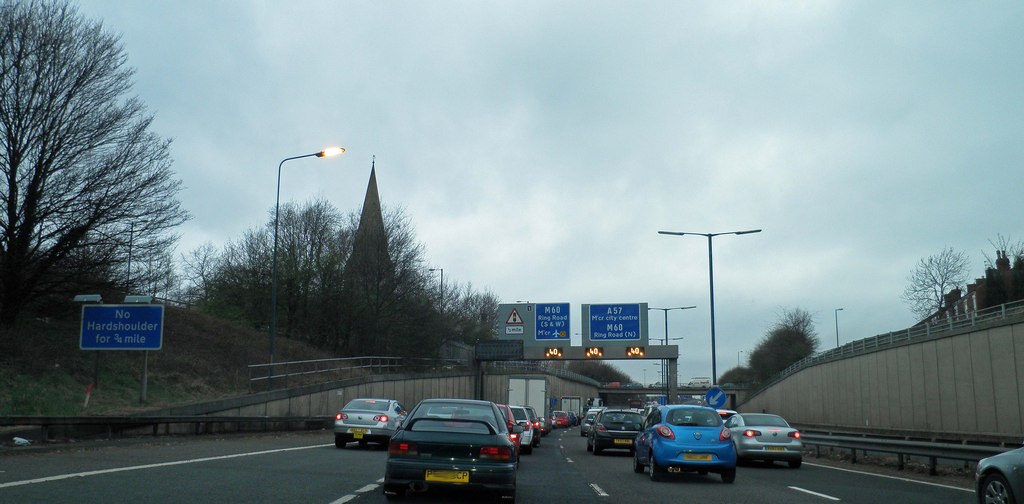
Motorway lane etiquette is one of those subjects that can turn a routine journey into an argument. The useful answer is simpler than the folklore: on a clear motorway, the left-hand lane is the default. The middle and right-hand lanes are for overtaking, not for cruising because the road feels more comfortable there.
That does not mean a driver must dart back to lane one after every vehicle, or that every car in the middle lane is automatically breaking the law. Traffic density, the spacing of lorries and upcoming junctions all matter. The point is to make a deliberate judgement, rather than treating the middle lane as a permanent home.
What the Highway Code actually says
Highway Code Rule 264 says drivers should keep in the left lane unless overtaking, and return to the left lane when it is safe after overtaking. It also tells drivers in lane one to consider moving out, where safe, to give more room to people and vehicles stopped on the hard shoulder or in an emergency area.
The word should matters. It is not the same wording as a rule marked MUST NOT. But the Highway Code can still be used in court to help establish liability, and its guidance is a sound benchmark for considerate driving. Repeatedly occupying lane two with an empty lane one alongside is hard to square with Rule 264.
When is it reasonable to stay in the middle lane?
There are plenty of normal situations where moving straight back to lane one would be needless or less safe:
- A continuous line of slower traffic is ahead. If you would only return left for a few seconds before overtaking the next vehicle, hold lane two and keep a proper following distance.
- Lane one is filling with vehicles joining from a slip road. Moving out can make space, provided you have checked mirrors, blind spot and the lane is clear.
- You are approaching a junction. Follow lane signs early. Do not make a last-minute move just to satisfy a rigid interpretation of “keep left”.
- The motorway is congested. In slow, busy traffic, lanes may move at different speeds. Rule 268 says you may keep up with traffic in your lane even if it means passing vehicles to the right, but it also says not to weave between lanes to overtake.
These are traffic-flow decisions, not invitations to sit in lane two while lane one is empty for a long stretch. Look well ahead and choose the lane that fits the next safe manoeuvre.
Why “I am doing 70” is not a defence for blocking lane two
The national speed limit is a limit, not a target and not a licence to prevent other traffic from overtaking. Even if you believe you are travelling at the maximum permitted speed, Rule 264 still applies. Do not try to police another driver’s speed by occupying an overtaking lane.
Equally, a driver coming up behind has no right to tailgate, flash headlights aggressively or force a gap. Leave space, stay calm and return left when it is safe. If someone is driving dangerously, let them go rather than escalating the situation.
Could middle-lane driving lead to a penalty?
There is no separate offence labelled “middle-lane hogging”. The risk is that the overall driving could be judged as careless or inconsiderate. Under section 3 of the Road Traffic Act 1988, driving without due care and attention, or without reasonable consideration for other road users, is an offence.
That is why this is more than a manners debate. A lane-two driver who creates an unnecessary queue, prompts risky undertaking or ignores a clearly empty lane one may attract police attention. The facts matter: road conditions, traffic, observation and the effect on other people are all relevant. It is not sensible to assume a fixed outcome from one snapshot or from a dash-cam clip alone.
How to use motorway lanes without causing trouble
- Start in lane one. Treat it as the normal running lane whenever it is available and appropriate.
- Plan overtakes early. Check mirrors, signal in good time and make a blind-spot check before moving right.
- Pass without lingering. Keep a safe gap from the vehicle you pass. Do not cut back in too soon.
- Return left when it is safe. Check mirrors again and move back smoothly. Do not force the move because another driver is impatient.
- Read signs before junctions. A lane can become an exit lane. Position yourself early instead of making a sudden cross-lane dash.
- Do not weave. Rule 268 is clear that repeatedly changing lanes to gain small advantages is not the answer.
What about two-lane dual carriageways?
The same principle applies. On a two-lane dual carriageway, keep left unless overtaking. There is no middle lane, but staying in lane two for no reason can still obstruct traffic and encourage poor decisions behind you. Watch for lane markings, junction signs and local speed limits, which may be lower than the national limit.
Do the same rules apply on smart motorways?
Yes. The lane-discipline rules still apply, but smart-motorway signs can change which lanes are available and the speed limit in force. A red X means that lane is closed and must not be used. On stretches where the hard shoulder is being used as a live lane, only use it when overhead signs show a speed limit above it. Rule 269 explains the distinction.
If traffic is heavy, avoid obsessing over whether the car beside you is technically overtaking. Concentrate on a safe gap, the signs above your lane and smooth, predictable progress. That is usually the best way to avoid both the middle-lane habit and the dangerous reactions it can provoke.
The practical rule to remember
On a clear road, move left. In a steady stream of traffic, choose the lane that lets you make safe, predictable progress without weaving. Use the right-hand lanes to overtake, not to set the pace for everyone else.
For more motorway safety advice, read our guide to what to do if you break down on a motorway and our explanation of the speed-camera tolerance myth.