If you are standing on the driveway wondering whether your own policy is showing correctly, there is a proper way to check. If you are trying to find out whether somebody else is insured, the rules are much tighter.
That split catches a lot of drivers out. Many people assume there is a public reg checker for any car on the road. There is not. In the UK, you can use the Motor Insurers’ Bureau service to check the insurance status of a vehicle you own or are legally entitled to drive. If you need the insurer details for another vehicle after an accident, that is a different route and usually a paid one.
Here is how the system works in 2026, what the result actually tells you, and what to do if the database says your car is not insured.
The quick answer
For your own vehicle, yes. MIB’s free Check Your Vehicle tool lets you see whether there is a live insurance policy recorded against the registration number.
For somebody else’s vehicle, no, not as a general public lookup. If there has been a crash and you need the other driver’s insurer details, the askMID enquiry route can help, but it is a separate service, it is designed for accident cases, and the enquiry currently costs £10.
The free UK check for your own car
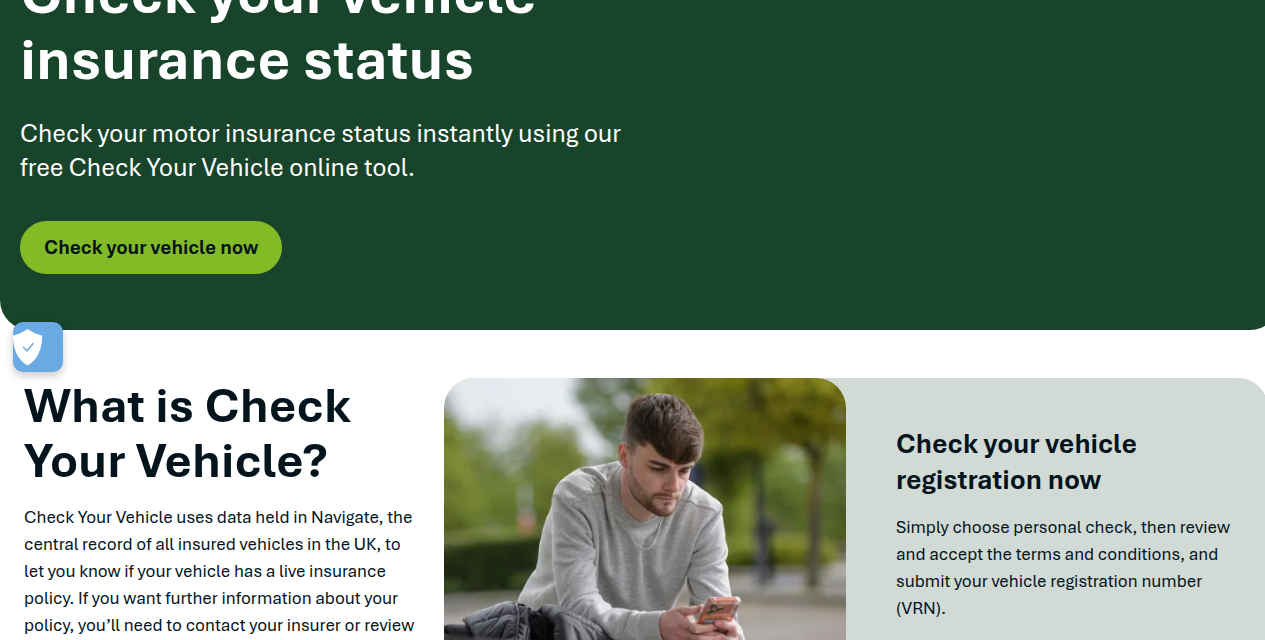
The public-facing service now promoted by MIB is called Check Your Vehicle. It uses data held in Navigate, which MIB describes as the central record of insured vehicles in the UK.
To run a check, you simply:
- go to the MIB Check Your Vehicle page
- choose the personal check route
- accept the terms
- enter the vehicle registration number
MIB says the service is free to use for this purpose.
That makes it a useful sanity check if:
- you have just bought or renewed a policy
- you changed insurer and want to make sure the old cover has not lapsed before the new policy appears
- you are unsure whether a policy amendment has been processed correctly
- you need reassurance before taxing a vehicle or putting it back on the road
What an "insured" result actually means
This is the bit drivers often get wrong.
An insured result does not mean every journey you make is automatically covered. According to MIB, it means there is a live insurance policy recorded against that vehicle.
That is not the same thing as saying:
- the policy covers the person currently driving
- the class of use is correct
- commuting, business use or delivery work is covered
- every named driver detail is accurate
- the address and occupation on the policy are up to date
In other words, the database can tell you that a policy exists, but it cannot tell you that your exact use of the car today is valid under the policy terms.
If you have recently changed address, use the car for work differently, or added another driver, do not treat a simple insured result as the end of the story. Check your certificate and schedule as well.
What if the result says your vehicle is not insured?
Do not panic, but do not ignore it either.
MIB says there are several reasons a vehicle may show as uninsured. One of the common ones is timing. If you have recently bought or renewed cover, the record may not have updated yet. MIB advises checking again after seven days and contacting your insurer if it still does not show as insured.
Until it does show correctly, keep your policy documents handy.
That matters because the legal risk is not small. GOV.UK says driving without at least third party insurance is illegal, and the police can issue a £300 fixed penalty and 6 penalty points. If the case goes to court, the fine can be unlimited, and the police can also seize, and in some cases destroy, the uninsured vehicle.
There is also a separate keeper issue. Under continuous insurance enforcement rules, a vehicle that is neither insured nor declared off the road with a SORN can lead to a £100 fine, wheel-clamping, impounding or court action with a maximum £1,000 fine, even if it is not being driven.
Can you check somebody else’s car for free?
Usually, no.
MIB’s own FAQ for Check Your Vehicle says you should only use the free service to run a validity check on your own vehicle. It also says that if you need another vehicle’s insurance status, your insurer or solicitor is authorised to carry out that check using another platform.
That is why the idea of a free public database for any random registration is mostly a myth.
There are good privacy reasons for that. MIB also makes clear that members of the public cannot access another person’s insurance data in the same way that insurers, solicitors, the police or the DVLA can.
What you can do after an accident
If you have had a road traffic accident and need to find the other vehicle’s insurer, the separate askMID enquiry service is the route aimed at private individuals.
At the time of writing, that service states that:
- it is for ad hoc searches after an accident
- you need the other vehicle’s registration and the accident date
- the enquiry fee is £10
- the result is not proof of insurance on its own
- if the registration is found, you may be shown the policy number, insurer name and claims contact details
That is useful if you are trying to progress a claim, but it is not a general-purpose tool for checking neighbours, sellers or cars you have seen advertised online.
What about checking a car before you buy it?
This is where many buyers hope for more access than they actually get.
If you are viewing a used car, you generally cannot use the free MIB tool to check whether the seller’s policy is active, because the service is intended for vehicles you own or are entitled to drive. And unless you are dealing with a post-accident case, the paid askMID enquiry is not built for routine used-car due diligence either.
For buyers, the better approach is to focus on checks you can legally and reliably make:
- confirm the car is taxed using the DVLA vehicle enquiry service
- check MOT history and advisories
- verify the V5C details make sense
- run a proper history check for finance, write-off markers and theft records
- make sure you have your own insurance in place before any test drive or collection
Insurance status is important, but it is only one part of a safe used-car purchase.
Does checking your own insurance trigger a credit search?
No. MIB says a Check Your Vehicle search does not create red flags or credit-style checks. It does, however, say searches are stored and shared with the Insurance Fraud Bureau for auditing purposes.
That should reassure drivers who want to check their record after a policy change without worrying that they are creating a mark against themselves.
A simple rule to follow
Use the free MIB tool for your own car.
Use the accident-only route if you need the other driver’s insurer after a collision.
Do not assume an insured result means every possible driver and every possible journey is covered.
And if your car shows as uninsured when you think it should not, sort it quickly. Insurance database delays do happen, but they are not something you want to discover after a police stop or a claim.
Bottom line
If your question is "is my car showing as insured right now?", the UK has a straightforward answer: MIB’s Check Your Vehicle service.
If your question is "can I look up anybody else’s insurance details?", the answer is mostly no, unless you are dealing with the aftermath of an accident and use the formal route designed for that purpose.
That is less convenient than many drivers would like, but it is the system as it stands. It protects personal data, keeps the public search limited, and still gives motorists a practical way to check their own cover before a problem becomes an expensive one.