If you want a cheap way into EV ownership, the used Nissan Leaf is still one of the most obvious starting points in the UK. It is easy to drive, widely available, and far less intimidating than many newer electric cars. But it is also one of those cars where the right example can feel sensible and the wrong one can feel compromised very quickly.
That is because buying a used Leaf is not just about age, mileage or trim. Battery condition matters, charging compatibility matters, and so does being honest about your daily mileage. Get those bits right and a Leaf can still be a practical local or commuter car. Get them wrong and you can end up with an EV that does not suit your life at all.
1. Start with which Leaf generation you are actually looking at
The oldest UK cars used 24 kWh or 30 kWh batteries. Later second-generation cars moved to 40 kWh, while Leaf e+ models brought a larger 62 kWh pack. That matters because the difference in daily usefulness is huge.
If you are shopping at the cheaper end of the market, an older 24 kWh car can still work for school runs, town use and short commutes. It is much harder to recommend if you regularly use dual carriageways, need winter range confidence or rely on public rapid charging.
For most buyers, the safer place to start is the second-generation 40 kWh Leaf sold from 2018 onwards. Parkers lists that car with an official range of 168 miles, while the larger-battery Leaf e+ goes up to 239 miles on the WLTP test. In the real world, especially in winter or at motorway speeds, expect less.
2. Ask about battery health before you get excited about the price
With a used EV, battery health matters more than a shiny bodywork finish or a low monthly finance figure. The key question is not simply how old the Leaf is. It is how much usable battery capacity remains and whether the car still suits your normal journeys.
On a Leaf, you want to look for any battery health evidence the seller can provide. The strongest answer is a recent state of health report from a specialist inspection, dealer check or a trustworthy OBD scan. If the seller has no battery report at all, ask for screenshots, service paperwork or at the very least clear dashboard photos that show the car’s battery bars and current indicated range at a sensible state of charge.
Do not treat the range showing on the dashboard as proof of battery condition. It is only an estimate based on recent driving and weather. A car that has just been driven gently around town can look more impressive than it really is.
3. Be stricter on older 24 kWh and 30 kWh cars
The cheapest Leafs can look tempting, especially if you only need a second car. The danger is that a very cheap EV can still become expensive if it forces you into workarounds, missed trips or an early resale.
An older small-battery Leaf can still be worth buying, but only when your use case is narrow and predictable. If you do not have home charging, if you often drive in winter at higher speeds, or if one car has to cover every household job, it is usually smarter to stretch to a healthier 40 kWh example.
This is the bit many buyers get wrong. They compare purchase price, assume any EV will be cheap to run, then realise the car only really works when everything goes to plan.
4. Do not ignore the Leaf’s charging setup
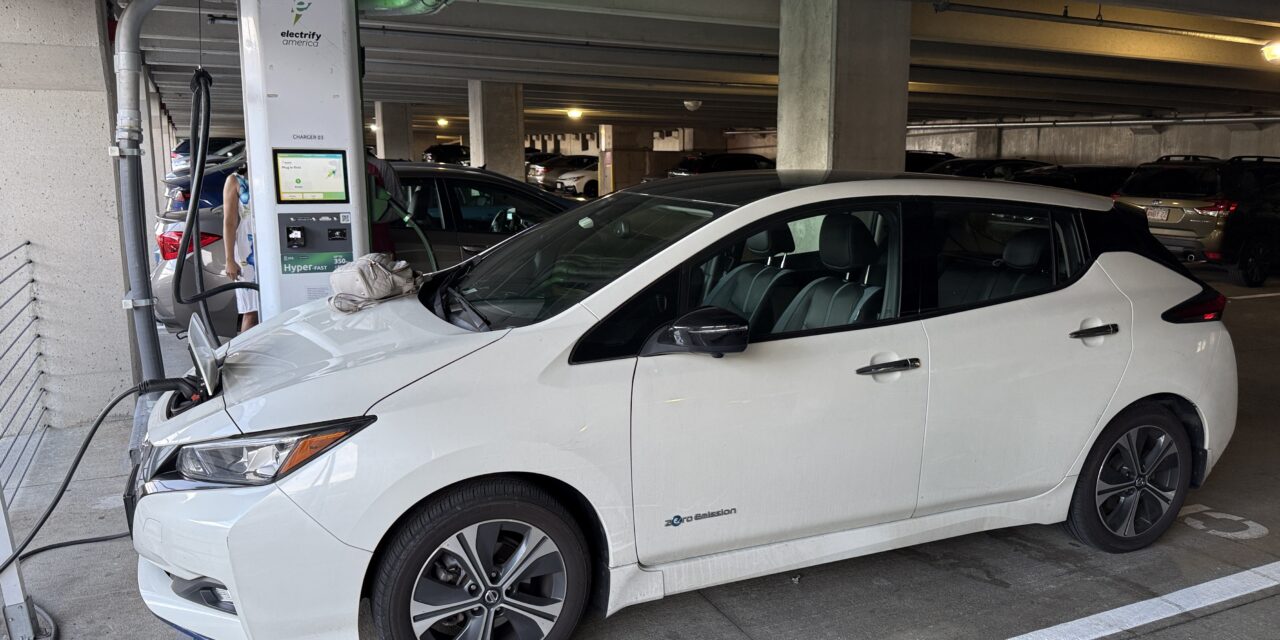
This is one of the biggest practical checks on any used Leaf. The car uses Type 2 for AC charging and CHAdeMO for rapid DC charging. That matters because most newer EVs in the UK now use CCS for rapid charging instead.
In plain English, you need to check your real charging life before you buy. Home charging is the Leaf’s comfort zone. If you can plug in at home and mainly top up overnight, the charging conversation gets much easier.
If you depend on public rapid charging, the Leaf needs more thought. Parkers points out that the car lacks the rapid charging connector now used by many newer rivals, and Zapmap’s charging guide confirms the Leaf relies on CHAdeMO for DC rapid charging. That does not make the car unusable, but it does mean you should check local routes and charging hubs rather than assume every rapid site will suit you well.
5. Check how you will really use public charging, not how you hope to use it
A used Leaf makes most sense for buyers who charge at home most of the time and use public charging as backup rather than as a lifestyle.
That is especially true because the second-generation car is limited to 50 kW DC rapid charging, and its AC on-board charger is 6.6 kW. Zapmap says a 40 kWh Leaf takes about 7.5 hours to charge to full on a 7 kW home wallbox and roughly an hour to reach 80 per cent on a 50 kW rapid charger, assuming conditions are favourable.
That can be perfectly acceptable if the car fits your routine. It is less attractive if you expect modern motorway-stop charging performance. Zapmap’s long-term Leaf test also noted charging can slow after repeated rapid charges in a day, which is another reason the Leaf is better as a home-charged commuter than as a regular long-distance workhorse.
6. Look beyond mileage and inspect the usual used-car basics properly
The Leaf is an EV, but it is still a used car and all the normal checks still matter. You still need to look at tyre quality, brake condition, suspension noises, accident repair quality, warning lights, service history and MOT history.
Pay close attention to tyres. Cheap mismatched tyres can suggest penny-pinching ownership, and EVs are sensitive to tyre choice because rolling resistance and grip affect efficiency and refinement. Listen for clonks over rough roads, feel for uneven braking, and make sure the car charges without fault messages.
Also check the charge cables included with the car. Replacing missing cables is an annoying extra cost, and some private sellers forget to mention they are not included.
7. Be realistic about motorway and winter range
This is where many used EV deals go right or wrong. Official figures help you compare versions, but your buying decision should be based on the miles you need on a bad day, not on the best number in a brochure.
Zapmap’s long-term test of the 40 kWh Leaf recorded real-world winter range of at least 110 miles on heavy dual carriageway and motorway use, with 130 to 140 miles more achievable on gentler mixed driving. That is useful context because it shows why some owners love the Leaf and others bounce off it.
If your regular drive is a 20-mile commute with home charging, that range is fine. If your routine includes long cold motorway runs with no reliable charging at either end, you may outgrow the car quickly.
8. Trim matters, but battery and charging matter more
It is easy to get distracted by bigger wheels, nicer seats or extra driver assistance kit. Those things are worth having, but they are not the core buying decision on a used Leaf.
A well-cared-for 40 kWh car with strong battery health and a charging setup that suits your life is usually a better buy than a flashier version that only wins on toys. The same logic applies when comparing a cheaper old car with a tired battery against a newer example that costs more upfront but is much easier to live with.
In other words, buy the Leaf that fits your journeys first, then your spec wishlist second.
9. Decide whether the Leaf fits your life today, not your plan for someday
The Leaf is no longer the default EV answer. Newer rivals are better on charging speed, longer-range flexibility and public-charger compatibility. Parkers is blunt on that point, and it is fair.
But that does not mean the Leaf is a bad used buy. It means it is a specific one. It still makes sense for buyers who want a simple, comfortable EV for short to medium trips, can charge at home, and are buying with open eyes about CHAdeMO and range.
It makes less sense if you want one car to do everything, rely heavily on public rapid charging, or know you will resent planning around battery limits in winter.
The smart way to buy a used Nissan Leaf
If you remember only three things, make them these: buy on battery condition, buy on charging suitability, and buy on your real mileage pattern.
For many UK drivers, the sweet spot is a tidy second-generation 40 kWh car with evidence of healthy battery condition, a complete charging kit and a routine that lets it live mostly on home charging. That is the version most likely to feel like a clever low-cost EV rather than a compromise you talk yourself into.
A used Nissan Leaf can still be a smart buy. You just need to judge it as an EV first and a bargain second.