
A motorway breakdown is one of the few driving problems where the order of your decisions matters more than diagnosing the fault. A warning light, puncture or loss of power can often wait. Getting yourself, your passengers and the vehicle away from fast-moving traffic cannot.
The Highway Code’s starting point is a place of relative safety. On a motorway, the best option is a service area. If that is not possible, an emergency area, lay-by or hard shoulder can be safer than stopping in a running lane. The exact response changes if you cannot get left, so keep the following sequence in mind: go left, get safe, get help.
1. Can you get the car to a safer place?
If the vehicle is still mobile, reduce speed smoothly, indicate and move to the left-hand lane. Leave at the next exit or reach a service area if you can do so safely. If not, use an emergency area, lay-by or hard shoulder where available. Do not try to nurse a seriously overheating engine, a car with a dangerous tyre failure or a vehicle that has lost power across several live lanes simply to reach a service station.
Once stopped, pull as far left as possible. Turn the wheels to the left, switch on the hazard warning lights and use sidelights too when it is dark or visibility is poor. If there is an emergency telephone, stopping just beyond it is helpful, provided it is safe to do so.
On an all-lane-running smart motorway, an emergency area is the purpose-built refuge marked by blue signs with an orange SOS telephone symbol. It is not a parking bay. If you can reach one, it is a much safer option than a live lane.
2. Should everybody leave the vehicle?
Only leave if the car is in a place of relative safety and it is safe and possible to get out. Use the door furthest from traffic and take passengers out on that side. Get behind a safety barrier if there is one, while watching for uneven ground, drops or debris. Keep children under close control.
Do not stand in front of or behind the car, and do not wait between it and traffic. A collision could push the vehicle into that space. Do not go back into the car because the weather is unpleasant, and do not attempt a roadside repair. On a motorway, changing a wheel or looking under the bonnet is not a sensible substitute for recovery.
Animals should normally stay in the vehicle. If there is an emergency that means an animal must come out, keep it under control on the verge.
If you are stranded in a live lane
This is the urgent exception. If you cannot get to the left lane or a place of relative safety, stay in the vehicle. Keep seat belts fastened, hazard lights on and call 999, asking for the police. If the car has an SOS or eCall button, press it and ask for the police. Do not attempt to cross motorway lanes or leave the vehicle into live traffic.
Tell the operator the motorway, direction of travel, nearest junction and any marker-post or driver-location-sign numbers you can see. A map app can help confirm your position. Mention anyone who may need extra help, such as a disabled, older or lone traveller.
3. Who should you call first?
Call 999 first if you are stopped in a live lane, cannot get out safely, there is a collision, fire, injury or an immediate risk to life. This is not the moment to start with a breakdown-app form.
If you are safely in an emergency area, lay-by or on a hard shoulder, use the roadside emergency telephone where one is provided before arranging recovery. It connects you to National Highways in England and gives the operator a precise location. You can then contact your breakdown provider. National Highways also advises drivers in a place of relative safety to seek assistance through the emergency phone or by phone.
When you speak to recovery, give the registration, a clear description of the fault, the direction you were travelling, your location and whether you are in an emergency area, hard shoulder, lay-by or a live lane. Tell them about vulnerable passengers, a trailer, pets or any reason the vehicle cannot be moved. Those details can affect the response they send.
What not to do on a motorway
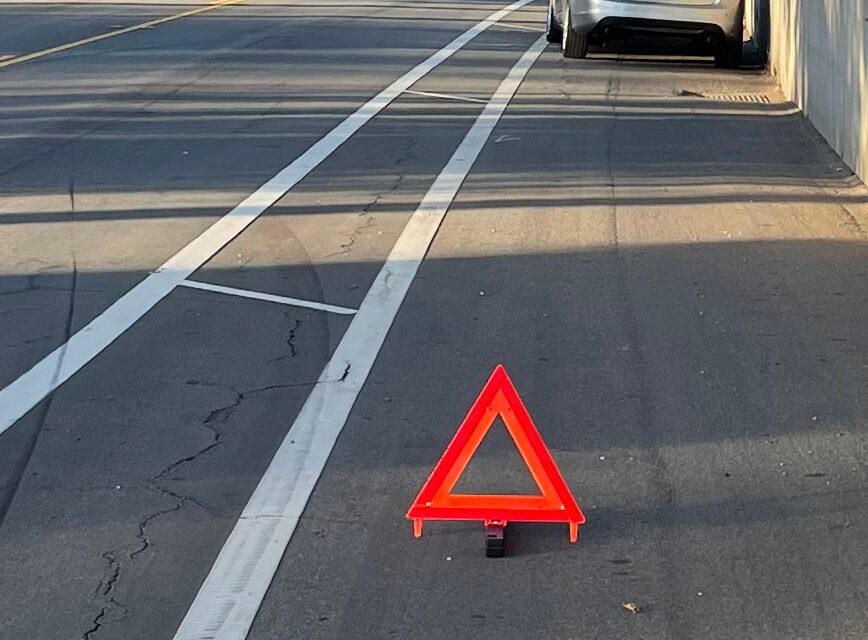
- Do not put out a warning triangle. The Highway Code says never to use one on a motorway. It requires walking on or beside a high-speed carriageway and may create another hazard.
- Do not try to repair the vehicle. That includes changing a wheel, topping up coolant or investigating under the bonnet.
- Do not walk to a telephone if the car is in a live lane. Stay belted in, hazards on, and call 999.
- Do not rejoin from an emergency area without using its emergency telephone. The Highway Code says to follow the operator’s advice. A lane may need to be closed before you pull out.
- Do not accept help from a passing driver by standing in danger. They should call for professional help rather than stop in an unsafe place.
How to leave an emergency area or hard shoulder
Leaving can be as risky as stopping. From an emergency area, use the emergency phone and follow the instruction you are given. Do not simply wait for a gap and accelerate out. On a hard shoulder, build up speed, indicate and join only when there is a safe gap. Watch for stationary vehicles, debris or people ahead on the shoulder.
If recovery is coming, stay well away from the carriageway and follow the recovery operator’s instructions. A roadside recovery is not an invitation to sit in the driver’s seat while work is being done.
A small motorway kit is worth carrying
It will not prevent every breakdown, but it can make a difficult wait safer and more manageable. National Highways recommends practical basics such as warm clothing, a hi-vis jacket, a torch, breakdown details, a charged phone, food, water and any essential medication. Keep the hi-vis jacket within reach, not buried beneath luggage. A portable charger is also useful, but do not delay a 999 call because you are trying to preserve battery.
Before a longer journey, check fuel or charge, tyres, lights and warning messages. If an amber or red warning appears, decide whether you can safely leave at the next exit rather than waiting for the vehicle to fail in a live lane.
Motorway breakdown checklist
- Get left and head for a service area, emergency area, lay-by or hard shoulder if it is safe.
- Stop as far left as possible, hazards on, wheels turned left.
- Leave by the side away from traffic only when safely stopped and able to do so. Get behind a barrier where possible.
- If stuck in a live lane or unable to get out safely, stay belted in and call 999 or use the SOS button.
- Use an emergency telephone in an emergency area, then contact recovery.
- Do not use a warning triangle or attempt repairs.
- Follow the operator’s advice before rejoining the motorway.
The bottom line
On any motorway, make safety the first repair. Get to a place of relative safety if you can. If you cannot, remain in the vehicle with belts and hazards on and call 999. Once you are somewhere safer, use the emergency telephone where available, tell recovery exactly where you are and do not take risks trying to fix the car yourself.
For the full legal and safety guidance, see Highway Code rules 275 to 278 and National Highways’ motorway breakdown advice.


Trackbacks/Pingbacks