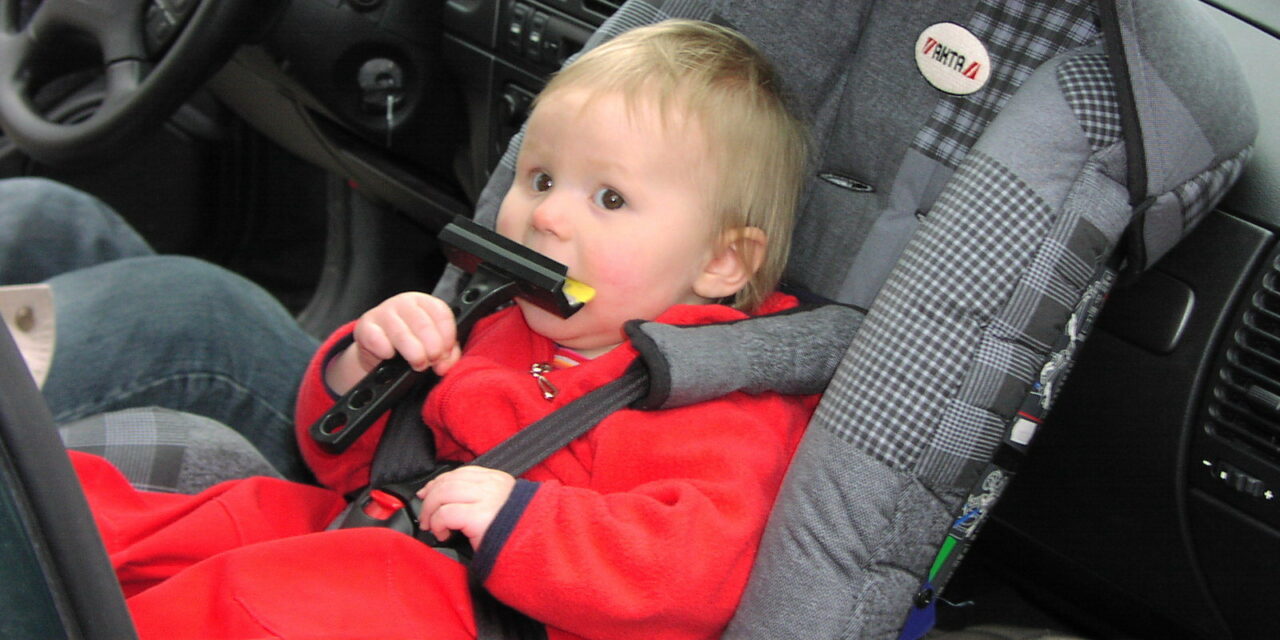
There is no single UK expiry age that applies to every child car seat. The useful answer is less convenient: check the exact seat’s label and instructions, then replace it when its manufacturer says so or when its history, condition or safety status gives you a reason not to trust it.
That matters because a restraint is a safety device, not a hand-me-down to judge by appearances. A seat can look tidy while its plastics, harness, adjuster, buckle or unseen structure have had a hard life. If you are buying, inheriting or reusing one, start with the evidence rather than the upholstery.
First, find the seat’s own limit
Look for a manufacturing date and any stated service-life or replacement information on the shell label, in the manual or on the maker’s support page. The location and wording vary by brand and model. Do not assume that an internet rule of thumb applies to the seat in front of you.
If the label is missing, the manual cannot be matched to the model, or the manufacturer cannot confirm the limit, treat that as a practical reason to replace it. You need to be able to identify the seat, check that it is approved for UK use and act on a safety recall.
Seven reasons to replace a child car seat
1. It has reached the manufacturer’s stated lifespan
Use the exact guidance for that model. The material condition of a seat depends on age, heat, sunlight, handling and storage, so a general number is no substitute for the maker’s instructions.
2. It was involved in a collision
Do not decide this by looking for a crack. A crash can load the shell, harness and energy-management parts in ways that are not obvious. Follow the seat manufacturer’s post-crash advice for the model. Your insurer may also have a process for a child-seat claim, but cover is not the same thing as a safety decision.
3. You cannot establish its history
A second-hand seat can be good value only when you know where it has been. Ask whether it has ever been in a collision, whether it has been dropped or checked in an aircraft hold, whether all parts are present, and whether it has spent years in a hot loft, damp shed or direct sun. If the answer is uncertain, walk away.
4. It has damage, missing parts or a fault
Cracks, stress whitening, distortion, a damaged harness, a buckle that sticks, frayed webbing, missing inserts or a loose base are not cosmetic details. Do not improvise a repair with tape, glue, a substitute bolt or a non-approved accessory. Contact the manufacturer if you are unsure whether a replacement part is approved for your exact seat.
5. It is subject to an unresolved recall or safety notice
Check the brand and model against the manufacturer’s safety notices before using a used seat. Have the model name, product code and manufacturing date ready. A recall may require an inspection, repair, replacement part or a different remedy. Until you know the outcome, do not assume the seat is fine.
6. Your child has outgrown the seat’s approved range
Replacing a seat because a child has outgrown it is just as important as replacing an old one. Check the approval label and manual, not just whether your child still looks comfortable. In the UK, children normally need a child car seat until they are 12 years old or 135cm tall, whichever comes first. A height-based seat is approved for a particular height range; a weight-based seat has its own stated range.
7. You cannot fit it correctly in the car you use
A sound seat fitted wrongly is not a safe solution. Check the vehicle handbook, the car-seat instructions and any compatibility list supplied by the manufacturer. Make sure the belt route or ISOFIX fittings are right, the support leg is suitable for that seating position, and the seat is stable. If you use a rear-facing infant seat in the front passenger seat, the front airbag must be deactivated.
What to check before accepting a used seat
- Find the model name, product code and manufacture date on the seat itself.
- Download the exact instruction manual and check that every part shown is present.
- Confirm the seat’s approved height or weight range and approval marking.
- Ask directly about crashes, drops, airline travel, storage and any replacement parts.
- Inspect the shell, harness, buckle, ISOFIX connectors, base and labels in good light.
- Check current manufacturer recalls or safety notices before handing over money.
- Try the installation in the actual car, following both manuals.
If a seller will not let you inspect the label or give a clear history, the saving is not worth the uncertainty. This is one item where a known history has real value.
Do not confuse legal approval with remaining life
UK rules require an appropriate child restraint in most circumstances, and approved seats carry the relevant approval marking. But a correct approval label does not prove that an old, damaged or unknown seat is still suitable. Approval, fit, condition and history are separate checks.
For the legal basics, GOV.UK’s child car seat guidance explains the height and weight-based rules and the requirement to deactivate a front airbag with a rear-facing seat. The manufacturer’s instructions remain the authority for the particular seat’s use, parts, recall status and replacement advice.
Should you replace a seat after a minor bump?
Do not use a generic online answer. Contact the manufacturer with the model details and a clear description of what happened, then follow its written advice. Explain whether airbags deployed, where the car was hit, whether anyone was in the seat and whether the seat or base made contact with anything. If the maker says replacement is required, do not keep using it while you wait for an insurance decision.
Before you fit the replacement
Register the new seat with the manufacturer if that option is available, keep the manual, and do a slow first installation rather than trying to learn it at the kerb. Recheck the fit whenever you move the seat between cars or alter the recline, head restraint or harness height. If you are unsure about the seating position, our guide to children travelling in the front seat covers the UK-specific points to consider.
The right time to replace a child car seat is not when it begins to look shabby. It is when the specific seat has reached its maker’s limit, its condition or history cannot be trusted, its child no longer fits its approved range, or its safety status is in doubt.