If your car’s MOT has expired, or it is close enough to expiry that you are wondering whether to bother renewing it before sale, the short answer is simple. Yes, you can sell a car in the UK without an MOT.
What catches people out is everything that comes after that.
A no-MOT car is harder for the next owner to drive away legally, harder to tax, and harder to market as a normal ready-to-use car. That does not make the sale impossible, but it usually changes the price, the kind of buyer you attract and the amount of hassle involved.
For most ordinary private sellers, the real decision is not whether a sale is legal. It is whether skipping the MOT will save enough time or money to outweigh the lower offers and smaller buyer pool.
Quick answer
You can sell a car without an MOT, but the missing test makes the handover much less straightforward.
GOV.UK says you cannot drive or park your vehicle on the road if the MOT has run out, with the main exceptions being to drive it to or from somewhere to be repaired or to a pre-arranged MOT test. GOV.UK also says a buyer must tax a vehicle before driving it, and that tax does not transfer with the sale.
In practice, that means a buyer usually cannot just turn up, pay, tax the car and drive away if the MOT has already expired. If the car needs a new test first, they may need to trailer it, move it to a test by prior arrangement, or organise repairs before it can return to normal road use.
Is it legal to sell a car without an MOT?
For a private seller, yes.
There is no rule that says a private seller must obtain a fresh MOT before advertising or selling a car. A car can change hands with no current certificate at all.
What the expired MOT changes is the car’s usability, not the fact that ownership can be transferred.
That matters because sellers often mix up three different things:
- whether the car can be sold
- whether the car can be driven on the road
- whether the buyer can tax it and use it straight away
Those are not the same question.
You can complete the sale, but if the MOT has expired the buyer may not be able to use the car in the way many people assume on collection day.
Why a no-MOT sale gets awkward so quickly
The awkward part is not the paperwork. It is the practical chain the buyer has to solve.
1. The buyer has to tax the car, and tax does not transfer
GOV.UK says the buyer must tax a vehicle before driving it and that the old tax does not carry over from the previous keeper.
So even if you have paid for tax right up to the end of the month, that does not help the person buying the car.
2. An expired MOT usually blocks the easy tax route
For most cars that are old enough to need an MOT, the lack of a valid certificate becomes a problem during the tax process.
We have covered that in more detail in our guide to taxing a car with no MOT, but the short version is that the order usually goes like this:
- book the MOT
- get the car tested and repaired if needed
- tax it once the MOT is valid
That is one reason buyers often lose interest when they hear "no MOT" in the advert.
3. Driving it away is not usually as simple as arranging insurance
Insurance is only one part of the puzzle.
Even if the buyer sorts cover in advance, they still need the car to be legal for the road. GOV.UK says you cannot drive or park a car on the road when the MOT has run out, except for specific trips such as going to a pre-arranged MOT test or to or from repairs.
So a buyer who wants to collect a no-MOT car usually needs a proper plan, not just a bank transfer and a spare hour.
If collection-day cover is part of the problem, our guide to drive-away insurance for a newly bought car explains the options that actually work.
When selling without an MOT can still make sense
There are situations where skipping the test is perfectly rational.
The car is worth very little
If the vehicle is already near the bottom of its value curve, an MOT test plus any fail items may cost more than the extra price you would win back.
That is especially true if the car has obvious faults, long-standing warning lights, corrosion worries or has been parked up for a long time.
You expect expensive failures
If you already know the car needs tyres, brakes, suspension work or emissions-related repairs, paying for the test may simply turn a private sale into a repair project you do not want.
In that situation, selling honestly as a no-MOT car for repair or spares can be the cleaner route.
The likely buyer is trade, auction or project-focused
A dealer, breaker, hobbyist or project buyer may be comfortable arranging transport and sorting the MOT later. Those buyers are less frightened by the logistics, though they will usually price that inconvenience in.
When getting a fresh MOT first is usually the smarter move
For an ordinary, usable car, a fresh MOT often makes life easier even if it is not strictly required.
1. It widens the buyer pool
Most private buyers want a car they can insure, tax and drive home without legal grey areas or transport costs.
A valid MOT makes that much easier.
2. It reduces suspicion
A missing MOT makes buyers wonder what the car is hiding, even when the answer is simply that you did not want the hassle.
A current pass does not prove the car is perfect, but it removes one obvious barrier and gives the advert a more normal shape.
3. It can support a stronger asking price
A no-MOT car usually attracts lower offers because the buyer is taking on uncertainty, admin and possible repair bills straight away.
If the car is likely to pass with minor or no work, paying for the MOT can be one of the cheaper ways to make it easier to sell.
4. You find out where you stand before the buyer does
That matters more than many sellers admit.
If the car fails badly, you can change strategy and sell it as a repair job with clear facts. If it passes, you can market it as a normal used car instead of inviting every buyer to negotiate from the worst-case assumption.
How to sell a no-MOT car without turning the sale into a mess
If you do decide not to renew the test, clarity matters.
State the MOT position plainly
Do not dress it up as "easy fix" unless you have proof. Say when the MOT expired, whether the car is currently on the road, and whether collection will need to be by trailer or by arrangement to a pre-booked test.
Point buyers to the MOT history
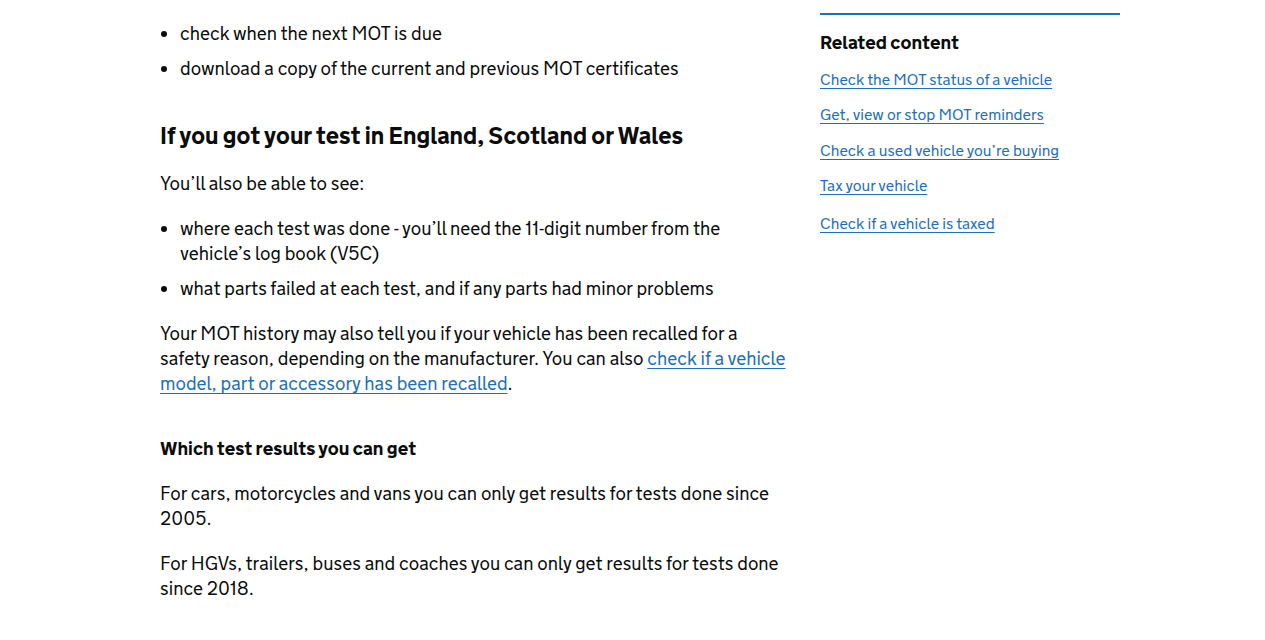
GOV.UK’s MOT history service shows whether the car passed or failed each test, the recorded mileage and, in Great Britain, the reasons for failures and advisory history.
That is useful for both sides. A buyer can see whether the car has been consistently cared for or whether the same faults keep coming back.
If you want to understand what those patterns tell a buyer, our guide on how to read a used car’s MOT history breaks it down.
Gather the rest of the paperwork
A no-MOT car is already a harder sell, so missing documents make it worse.
At minimum, have the V5C details straight and gather service records, invoices and any recent repair evidence you still have. Our used car paperwork checklist covers the records buyers normally want to see.
Price for convenience, not hope
If the lack of MOT means the buyer may need transport, repairs and extra admin before using the car, the market value is not the same as an equivalent tested example.
This is where many listings stall. Sellers price the car as if the missing MOT is a small footnote. Buyers price it as a problem to solve.
Tell DVLA as soon as the vehicle is sold
Once the deal is done, complete the keeper change promptly. GOV.UK’s service for telling DVLA you have sold or transferred a vehicle is the key step that protects you from future tax, penalty and enforcement headaches.
A simple rule for deciding what to do
If the car is basically sound and likely to pass, getting the MOT done first is usually the better private-sale move.
If the car is low-value, obviously faulty or likely to need more money than it is worth, selling it without an MOT may be the sensible choice, but only if you are realistic about the lower price and harder handover.
The bottom line
Selling a car with no MOT is legal, but it rarely feels simple to the buyer.
The real problem is not the sale itself. It is that the next owner usually cannot treat the car like a normal road-ready purchase until the MOT, tax and insurance pieces line up properly.
That is why a fresh test is often worth doing on any car with normal private-sale appeal. It removes friction, broadens the audience and usually gives you a better chance of a clean, quick handover.
If the car is not worth that effort, be upfront, price it accordingly and assume the serious buyers will be the ones who already know how they are going to move it.