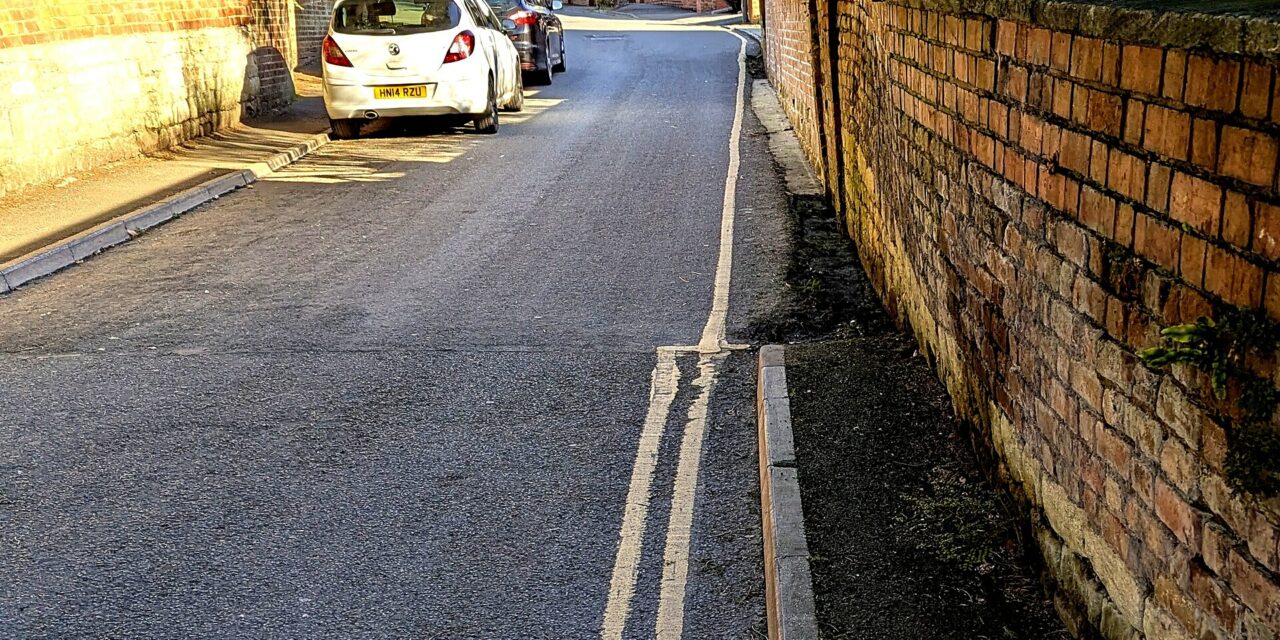
The short answer: you can park on a single yellow line only when the restriction is not in force and no separate rule prevents it. The line is not a blanket all-day ban, but it is not a safe bet either. The hours are set locally, so the sign is the thing to read before you switch off.
A single yellow line controls waiting. In ordinary language, that means parking up and leaving the car. It does not give a national free pass on Sundays, evenings or bank holidays. The restriction might apply for an hour, all day, every day, or at another period stated on the relevant sign.
Start with the nearby time plate
Look for a rectangular yellow-and-black sign beside the road. It should state the days and times when waiting is prohibited. If it says Monday to Saturday, 8am to 6.30pm, for example, the single yellow line can normally be used outside those hours, subject to the other restrictions on the street.
Do not assume there must be a sign immediately next to the space. In a controlled parking zone, signs at the entrance to the zone can set the hours for single yellow lines within it. The zone-entry sign is therefore worth checking when you drive in, especially where individual plates are absent. A restriction may also change along the same road, so check again after a junction or where the markings change.
The Highway Code says drivers must not wait or park on yellow lines during the times of operation shown on the accompanying signs. That is the practical rule to use, rather than relying on an old local habit or a search result about another town.
What a single yellow line does, and does not, tell you
- It tells you that waiting is restricted at certain times. It does not tell you those times by itself.
- It is different from double yellow lines. Double lines normally prohibit waiting at all times, although separate loading rules and local exemptions can still matter.
- It is not a loading bay. A marked bay, its sign and any wording such as “Loading only” create their own rules.
- It does not cancel other parking rules. You can still be in the wrong place even if the yellow-line restriction has ended.
For the visual distinction, see the Department for Transport’s Highway Code road-markings guide. The important point at the kerb is that the line and the sign work together.
Check for kerb marks before you load or unload
Short yellow marks on the kerb, or on the edge of the carriageway, can mean a loading restriction. One kerb mark denotes a restriction at certain times; two denote a restriction at all times. A nearby plate gives the relevant hours.
This catches out drivers who think they can stop briefly on a single yellow line to collect a bulky item. Loading may be permitted while the waiting restriction is not in force, and in some places during it, but a kerb loading restriction changes that. If there are kerb marks and a plate says no loading, do not treat putting bags in the boot as a loophole.
Why Sunday is not an automatic yes
Some single-yellow restrictions end on Saturday evening. Others run on Sundays, on bank holidays or every day. Town centres, transport hubs and busy shopping streets often have longer controls than nearby residential roads. The answer is always the signed hours for that location.
Where a sign uses a phrase such as “Except permit holders”, read it in full. A resident’s permit, pay-and-display ticket or visitor permit does not automatically override a single-yellow waiting restriction. The relevant traffic order and the council’s signs govern the bay or line you are using.
Five checks before you leave the car
- Read the nearest time plate. Check days, hours and any wording about permits or loading.
- Look back to the zone entrance. If you are in a controlled parking zone, its entry sign may provide the operating hours.
- Inspect the kerb. Yellow kerb marks can remove any loading allowance.
- Check the exact spot. Do not stop on a crossing zig-zag, bus stop clearway, taxi rank, disabled bay, cycle lane or dropped kerb just because the yellow-line hours have finished.
- Use the council’s parking map if unsure. It can help, but signs and markings at the location come first. If the restriction is not clear, choose a signed bay or park elsewhere.
Can you stop to pick someone up?
There is a difference between waiting and a genuinely brief stop for passengers to get in or out. But that is not a licence to park up, wait for a text message or leave the vehicle. Other controls can ban stopping altogether, and the Highway Code’s rules on crossings, clearways and dangerous positions still apply. If you need more than a moment, find a permitted bay.
Blue Badge holders and local exemptions
Blue Badge concessions vary by nation and council, and the badge does not override every restriction. In England and Wales there are circumstances in which a holder may wait on yellow lines for up to three hours, provided there is no loading ban and the required clock is displayed, but there are important local exclusions. London and central areas can be more restrictive. Check the issuing authority’s current guidance and the roadside signs rather than relying on a general rule.
What happens if you get it wrong?
On streets enforced by a local authority, parking during the restricted hours can lead to a penalty charge notice. The amount, discount period and challenge process depend on the authority and the contravention. Take clear photos of the car’s position, every relevant sign, kerb marks and the line if you believe a restriction was unclear or signed incorrectly. Photographs are evidence, not a reason to remain in a restricted space.
The sensible rule
Single yellow lines are designed to be flexible, which is why they are easy to misread. Treat the paint as a warning that you need one more piece of information. Read the sign, check for kerb marks, and make sure no other restriction applies. If you cannot establish that parking is permitted, do not gamble on a ticket.