Missing a vehicle tax Direct Debit is one of those admin slips that can turn into a proper problem if you assume the system will quietly sort itself out. It will not.
The good news is that one failed payment does not automatically mean you are instantly driving an untaxed car. The bad news is that if the second collection fails, the Direct Debit is cancelled, the vehicle is no longer taxed, and you cannot legally keep driving it until you tax it again.
That is the point many drivers get wrong.
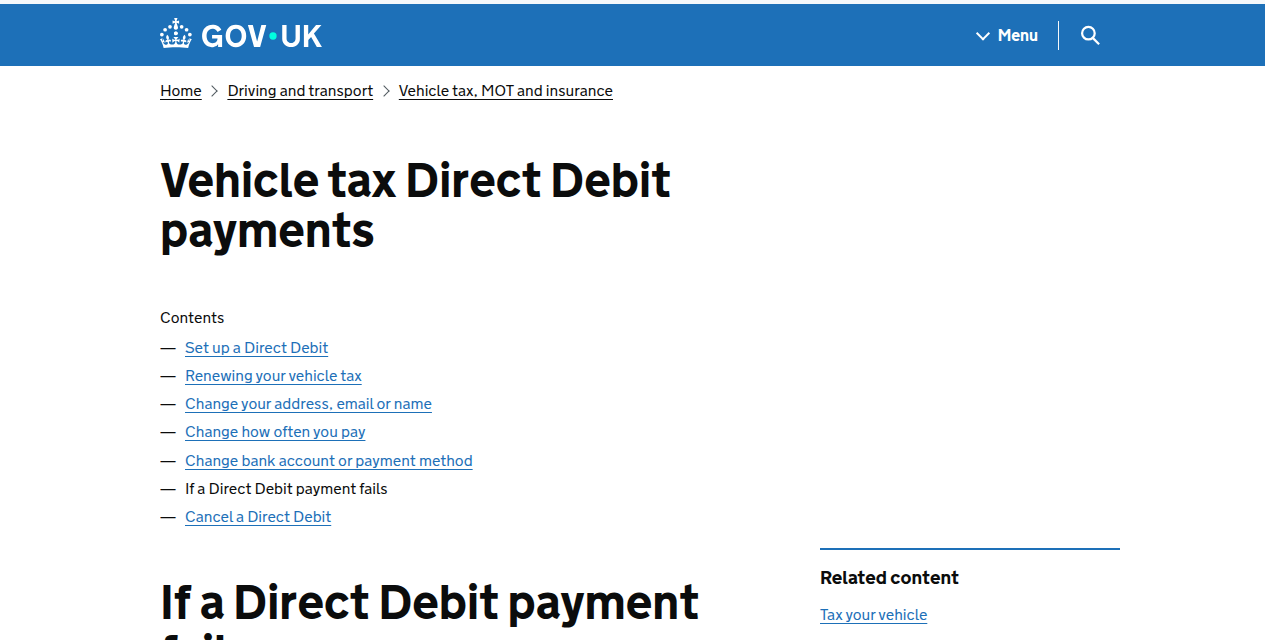
According to the official GOV.UK guidance on failed vehicle tax Direct Debit payments, the DVLA will email the Direct Debit account holder if a payment fails because there is not enough money in the account. It will then try to take the payment again within 4 working days. If that second attempt also fails, you will be told that the Direct Debit has been permanently cancelled and that your vehicle is no longer taxed.
The short version
If you only need the quick answer, this is the rule of thumb:
- if one payment fails, the DVLA says it will try again within 4 working days
- if the second attempt fails, the Direct Debit is cancelled and the vehicle is no longer taxed
- once the vehicle is no longer taxed, it is illegal to drive it until you tax it again
- if you are not going to retax it straight away, you need to declare it off the road with a SORN
- if you do nothing, the DVLA says you can be fined £80 and still have to pay the missing tax
What actually happens after the first failed payment
This is the part worth slowing down for.
GOV.UK does not say that the car becomes untaxed the second the first payment bounces. It says the DVLA will email the account holder and try to take the payment again within 4 working days.
So if you spot the problem early, you still have a chance to make sure there is enough money in the account before that second attempt. In practice, that means checking the account the Direct Debit comes from, reading the DVLA email carefully, and not assuming the next collection will somehow happen without you fixing the underlying problem.
Common causes include:
- not enough money in the account on collection day
- changing bank accounts and forgetting to update the Direct Debit
- a cancelled or blocked Direct Debit mandate
- an old email address meaning you miss the DVLA warning
If the issue was simply lack of funds, the smart move is obvious. Get enough money into the account immediately and keep it there until the retry has happened.
When your car actually becomes untaxed
The critical point is after the second failed collection, not the first.
The DVLA says that if the retry also fails, you will get another email explaining two things: the Direct Debit has failed twice and been permanently cancelled, and your vehicle is no longer taxed.
That wording matters because it answers the question drivers usually ask in a panic: can I still drive the car?
Once that second failure has happened and the vehicle is no longer taxed, the official answer is no. GOV.UK states that it is illegal to drive the vehicle until you have taxed it.
That means this is not a paperwork issue to leave until the weekend. It is a stop-driving-and-fix-it issue.
What to do straight away if the Direct Debit has been cancelled
If you have had the cancellation email, take these steps in order.
1. Do not keep driving on assumption
If the DVLA says the vehicle is no longer taxed, treat that as the end of the road for using it until the tax is set up again. Do not rely on guesswork, and do not assume that insurance, MOT status or the fact the car was taxed last month somehow covers you. Vehicle tax is its own legal requirement.
2. Retax the vehicle using the V5C
GOV.UK says you will need to tax the vehicle again using the vehicle log book, also known as the V5C.
You then have two basic routes:
- make sure there is enough money in an account and set up a new Direct Debit
- pay using another method, such as a debit card or a Direct Debit from a different account
If your V5C is missing, read our guide on how to tax a car without a V5C in the UK, because the route changes depending on what documents you still have.
3. Check the vehicle status once the tax is back in place
If you want peace of mind before driving, use the official GOV.UK vehicle tax checker to confirm the car shows as taxed. That takes minutes and avoids guessing.
4. If the car is staying off the road, make a SORN instead
If you are not going to tax it again immediately, the DVLA says you need to tell it the vehicle is off the road. In practice that means making a Statutory Off Road Notification.
If you need the practical steps, our guide on how to SORN a car properly covers what happens next.
What if you do nothing
This is where a small banking mistake turns into an avoidable penalty.
GOV.UK says you will be fined £80 if you do not tax the vehicle or tell the DVLA it is off the road. You will also have to pay for the period when the vehicle was not taxed.
That is the official baseline. It can get worse if you continue ignoring it. The same guidance warns that if the fine is not paid on time, the vehicle could be clamped or crushed, or your details could be passed to a debt collection agency.
So the expensive part is usually not the missed Direct Debit itself. It is the inertia afterwards.
The mistake that catches drivers out
A lot of people think a failed monthly payment works like a missed Netflix subscription. It does not.
Vehicle tax is not just another subscription sitting quietly in the background. It is tied to whether the vehicle is legally taxed. Once the Direct Debit is cancelled after a second failure, this stops being a billing issue and becomes a legal use-on-the-road issue.
That is why it is risky to tell yourself you will sort it when the reminder comes through the post, when payday lands, or when you next have half an hour free. By then, the car may already be untaxed.
Can you be caught if you do drive it?
The sensible answer is not to test it.
The UK already has automated enforcement around untaxed vehicles, and the official guidance is clear enough that there is no grey area once the DVLA has cancelled the Direct Debit and told you the vehicle is no longer taxed. If you need to move the car after that point, retax it first.
If you are unsure whether the problem has already escalated, check your email, log into the bank account the Direct Debit uses, and verify the vehicle’s status through GOV.UK before you turn the key.
How to stop this happening again
The easiest fix is not clever. It is admin.
A few habits help a lot:
- keep the Direct Debit on an account that always has a small buffer
- update the DVLA if your email address changes
- check that bank switches or replacement cards have not disrupted the mandate
- open DVLA emails rather than assuming they are just routine reminders
- if you are selling, scrapping or SORNing the vehicle, check what should happen to the tax payments afterwards
We have already covered one related trap in our article on car tax Direct Debit payments that keep running after you sell, scrap or SORN a vehicle. The common thread is simple: with vehicle tax, assumptions get expensive.
The bottom line
If you miss one car tax Direct Debit payment, the DVLA says it will try again within 4 working days. If that second attempt fails, the Direct Debit is cancelled and your vehicle is no longer taxed.
From that point, do not keep driving and hope for the best. Retax the vehicle using the V5C, or make a SORN if it is staying off the road.
This is one of those problems that is cheap to fix quickly and annoyingly expensive to ignore.