If a car looks cheap for its age and mileage, the missing piece is sometimes not the service history or the tyre tread. It is where you plan to drive it.
A used car that seems like a bargain can become much harder to live with if it triggers daily Clean Air Zone charges on your regular routes. That matters most for buyers in and around cities such as Bath, Birmingham, Bradford, Bristol, Portsmouth, Sheffield and Tyneside, where the official GOV.UK checker is the first place to look.
This is not just a London problem, and it is not something to leave until after you have paid a deposit.
Why this check belongs on your used-car shortlist
When drivers compare two similar used cars, they usually look at price, mileage, insurance group, fuel economy and MOT history. Clean Air Zone charges deserve a place on that list as well.
If one car can drive through your local zone without a daily fee and another cannot, that difference can affect:
- your true monthly running costs
- whether the car still makes sense for commuting or school runs
- how easy it will be to sell later in your area
- how much negotiating power you have before you buy
The point is simple. A cheaper used car is not automatically the cheaper car to own.
The free official checker most buyers should start with
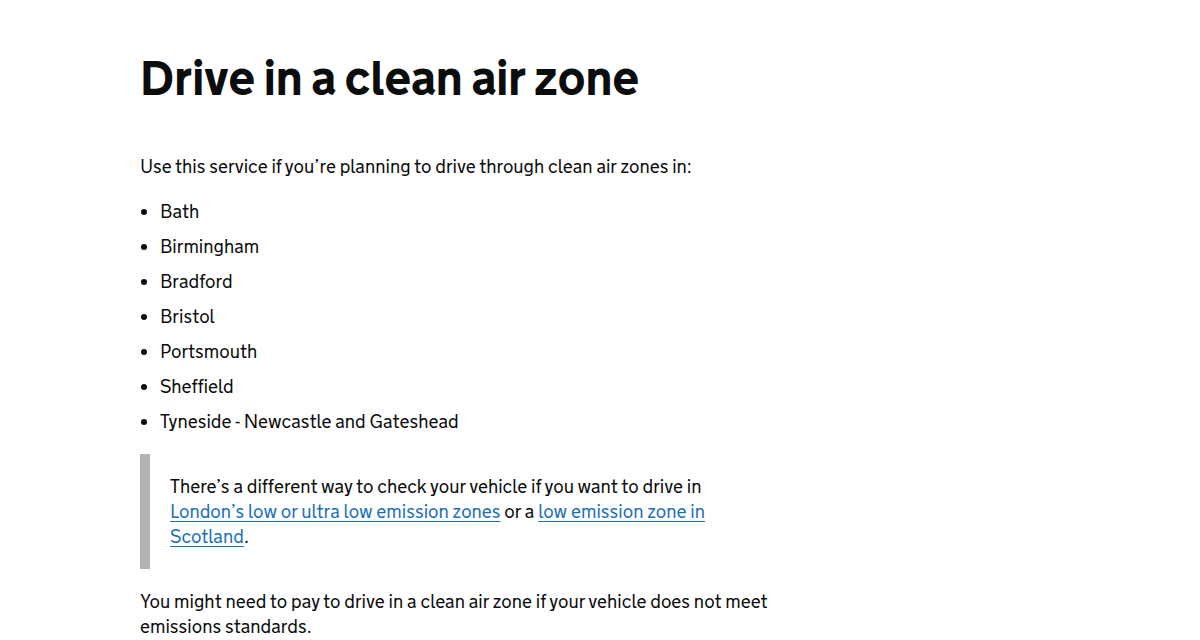
The government service at GOV.UK lets you check whether a vehicle may need to pay in the Clean Air Zones currently covered by that system. At the time of writing, the page lists Bath, Birmingham, Bradford, Bristol, Portsmouth, Sheffield and Tyneside, covering Newcastle and Gateshead.
You only need the registration number to start. The same service also lets you view zone maps and pay a daily charge if one is due. It cannot check vehicles registered outside the UK, which is worth remembering if you are looking at an import.
If you are comparing cars from dealer adverts, ask for the registration before you travel. If a seller will not provide it, that is not a great sign anyway.
Do not confuse Clean Air Zones with London ULEZ
This catches buyers out all the time.
The GOV.UK Clean Air Zone checker does not cover London. The government page itself points drivers to a separate Transport for London route for London low emission and Ultra Low Emission Zone checks.
That matters because a car can fit your plans outside London but still be a poor choice if you regularly drive into the capital. TfL says the ULEZ operates across all London boroughs, runs 24 hours a day every day of the year except Christmas Day, and charges £12.50 a day for non-compliant cars, motorcycles, vans and minibuses in the covered weight classes.
So if the car may ever need to go into London, do both checks:
- the GOV.UK Clean Air Zone check for the English city zones it covers
- the TfL vehicle checker for London
If Scotland matters to you, there is a separate Low Emission Zone checker there too.
How to use the check properly before buying
A quick registration check is useful, but it works best as part of a buying process.
1. Check the registration before you arrange the viewing
Do this as early as possible. If a car fails the zone test for the places you actually use, you may save yourself a wasted trip.
2. Check the car against your real driving pattern
A zone result only matters if it affects where you go. A non-compliant car might still suit a buyer who never goes near a charging zone. For another driver, the same car could become a daily headache.
Be honest about your routes. Commute, childcare, family visits, airport runs and weekend city trips all count.
3. Run the London check separately if relevant
Do not assume that one clean air result covers every city. If London is on the list, verify London separately through TfL.
4. Save the result
Take a screenshot or keep a note while you are shopping around. It makes it easier to compare cars later and gives you something concrete if a dealer described the car as compliant.
5. Recheck before you pay
Listings get updated, number plates can be mis-typed and private plates can complicate things. A final check on the correct registration takes seconds and can save a lot of irritation.
What this means for your negotiating position
Used car buyers often focus on visible flaws because they are easier to argue over. Scratches, kerbed alloys and worn tyres are obvious. Zone charges are easier to miss, which is exactly why they can matter in negotiation.
If a car does not suit your local charging rules, you can make one of three sensible decisions:
- walk away
- buy only if the price properly reflects the drawback
- keep looking for a compliant alternative
The strongest negotiating position is usually before you have emotionally committed to that exact car.
Seller claims are not enough on their own
You will sometimes hear phrases like these in adverts or messages:
- ULEZ friendly
- should be Clean Air Zone compliant
- never had an issue in town
- same engine as the compliant one
None of that is a substitute for checking the registration yourself.
A seller may be honest but mistaken. They may be talking about London when you need a different city, or they may be relying on a rough rule of thumb rather than the actual registration result.
If a dealer markets a car as compliant, keep a copy of the advert and confirm it with the official checker before you sign anything.
What if the seller will not share the registration?
Treat that as a warning sign, especially if the car is advertised as ideal for city use.
There can be harmless reasons for withholding a plate in a public advert, but a serious seller should usually be able to give it to a genuine buyer who is arranging a viewing or trying to do sensible due diligence.
If they still refuse, it is often smarter to move on to another car.
A good result does not replace the rest of your checks
A car that clears Clean Air Zone checks can still be a bad buy. You still need the usual basics:
- MOT history
- service record
- finance and write-off checks
- tyre condition
- warning lights
- paperwork and ownership details
- insurance cost
Think of zone compliance as one part of the ownership-cost picture, not the whole picture.
The bottom line
If you are buying a used car in the UK, a free Clean Air Zone check is one of the easiest ways to avoid an expensive mismatch between the car and the places you actually drive.
The official GOV.UK service is quick, free and covers the main English city Clean Air Zones in its system. London needs its own TfL check, and Scotland uses a separate Low Emission Zone checker.
That means the smart move is not to ask whether a car is probably fine. It is to check the registration before you agree the price, before you leave a deposit and before you drive home convinced you found a bargain.