If you have parked on a public road, do not leave the engine running just to warm the cabin or clear the windscreen. The Highway Code says you must not leave a parked vehicle unattended with its engine running, and you must not leave an engine running unnecessarily while a vehicle is stationary on a public road.
That is the short answer to a common cold-morning question. It does not mean an engine has to be switched off every time a queue stops moving, but it does mean that sitting at the kerb with the car idling is not a harmless default.
What the Highway Code actually says
Rule 123 of the Highway Code deals with the driver and the environment. It says drivers must not leave a parked vehicle unattended with its engine running, or leave the engine running unnecessarily while the vehicle is stationary on a public road.
It then gives a sensible rule of thumb: if the vehicle is likely to be stopped for more than a couple of minutes, apply the parking brake and switch off the engine. The purpose is to reduce exhaust emissions and noise.
The rule is backed by the Road Vehicles (Construction and Use) Regulations. Regulation 98 requires the driver of a stationary vehicle to stop machinery as necessary to prevent noise or exhaust emissions. Regulation 107 separately requires an unattended motor vehicle on a road to have its engine stopped and its parking brake effectively set, except in limited circumstances.
Is warming up your car illegal?
The important words are “unnecessarily”, “stationary” and “on a public road”. There is no rule requiring you to turn the engine off while you are waiting in moving traffic, at a red light or in a queue that may start again at any moment. Rule 123 specifically recognises that the engine may run when a vehicle is stationary because of traffic, or while a fault is being diagnosed.
But leaving a car at the kerb to idle while you finish breakfast, scrape the glass or go back indoors is different. If it is unattended, Rule 123 is unambiguous. Switch it off and take the key with you.
A private driveway is not a public road, so the specific wording in Rule 123 is not a blanket ban on starting your car there. Even so, prolonged idling still creates unnecessary noise and pollution, and a vehicle left unlocked and running is an obvious theft risk. It is also rarely the best way to get a car ready.
Demist first, then drive
The safer routine on a frosty morning is straightforward:
- Start the car only when you are ready to stay with it.
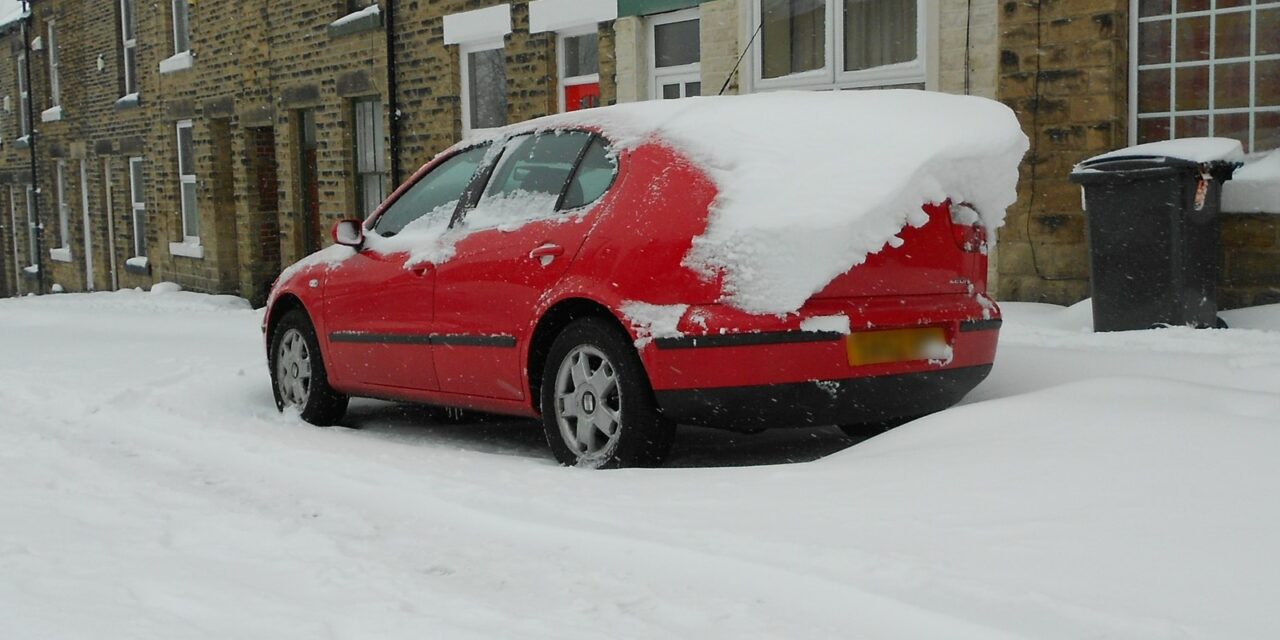
- Clear snow, ice and condensation fully from the windscreen, side windows, mirrors, lights and number plates.
- Use the front and rear demisters, with the air conditioning switched on if your car uses it to dry the air.
- Set the fan and temperature to clear the glass, then give the engine a gentle start by driving away smoothly.
Rule 230 of the Highway Code says you should make sure windows and lights are clean and clear before setting off. A small clear patch in the windscreen is not enough. For a practical guide, see Motoring Mojo’s advice on clearing a frosted windscreen properly, and do not forget to remove snow from the car roof before joining the road.
Why idling is not the best way to warm a modern car
Most modern petrol and diesel cars warm up more effectively when they are driven gently than when they sit still. The cabin may feel warmer eventually while idling, but the engine, gearbox and other components do not reach normal operating temperature as efficiently as they do under light load.
The answer is not to drive hard from cold. Avoid high revs and heavy acceleration until the car has warmed through. Just do not mistake a long idle for good mechanical care. It burns fuel without covering any distance and leaves exhaust emissions where pedestrians, neighbours and schoolchildren may be standing.
For an electric car, there is no tailpipe idling issue, but the security and visibility rules still matter. If your EV has a preconditioning timer or app, use it while the car is securely parked and charging where appropriate. That can warm the cabin and clear the glass before departure without relying on an engine.
What if you need to stop at the roadside?
If you stop because of a breakdown or emergency, safety comes first. The Highway Code’s rules allow for situations where a vehicle is stationary because of traffic or a fault is being investigated. But do not leave the engine running and walk away from the vehicle.
On an ordinary roadside stop, Rule 252 says you must switch off the engine, headlights and fog lights, apply the handbrake, secure the vehicle and lock it before leaving. A motorway breakdown needs a different response, covered in our guide to what to do before recovery arrives.
The practical bottom line
If you are parked on a public road, do not leave the engine running unnecessarily, and never leave the car unattended with it running. For demisting, stay with the car, clear every window properly and set off only when you can see clearly. A couple of careful minutes is safer, quieter and more considerate than an unattended cold-morning idle.