
A puncture is a bad time to discover that the boot contains no spare wheel, no jack and a tyre sealant bottle that expired years ago. Plenty of UK cars do not have a conventional spare as standard, so it is worth checking your own car rather than assuming the toolkit is there.
The answer changes what you should carry, what a breakdown company can realistically do at the roadside and whether a long journey needs a little more preparation. It is also worth checking when buying used: a missing spare or repair kit can turn an apparently small saving into an immediate bill.
Start with the boot floor, then check the handbook
Lift the carpeted boot floor or open the underfloor compartment. A full-size spare, a narrow space-saver, a foam tray holding a compressor and sealant bottle, or an empty well are the usual outcomes. On some cars the wheel is mounted beneath the boot or at the rear, so consult the vehicle handbook if the underfloor area is empty.
Do not stop at spotting a wheel. Check that it is actually secured, that the jack and wheel brace are present, and that any locking-wheel-nut key is with them. A wheel nut key is often a small adaptor rather than an obvious tool, so look in the foam insert, glovebox and service-wallet area as well.
The handbook is the authority for your exact version. A spare may have been standard on one trim, optional on another and removed when the car was specified with a larger wheel, a third-row seat or a hybrid battery. The handbook also tells you the correct jacking points and the tyre pressures for the spare.
What you might find
A full-size spare
This is the most flexible option, but it still needs checking. Match its size and specification to the handbook, inspect the sidewall for cracking or damage and check the pressure. A full-size spare can be a matching alloy or a steel wheel. If it uses a different tyre specification, treat the handbook as the rule on where it can be fitted and how it should be used.
A space-saver spare
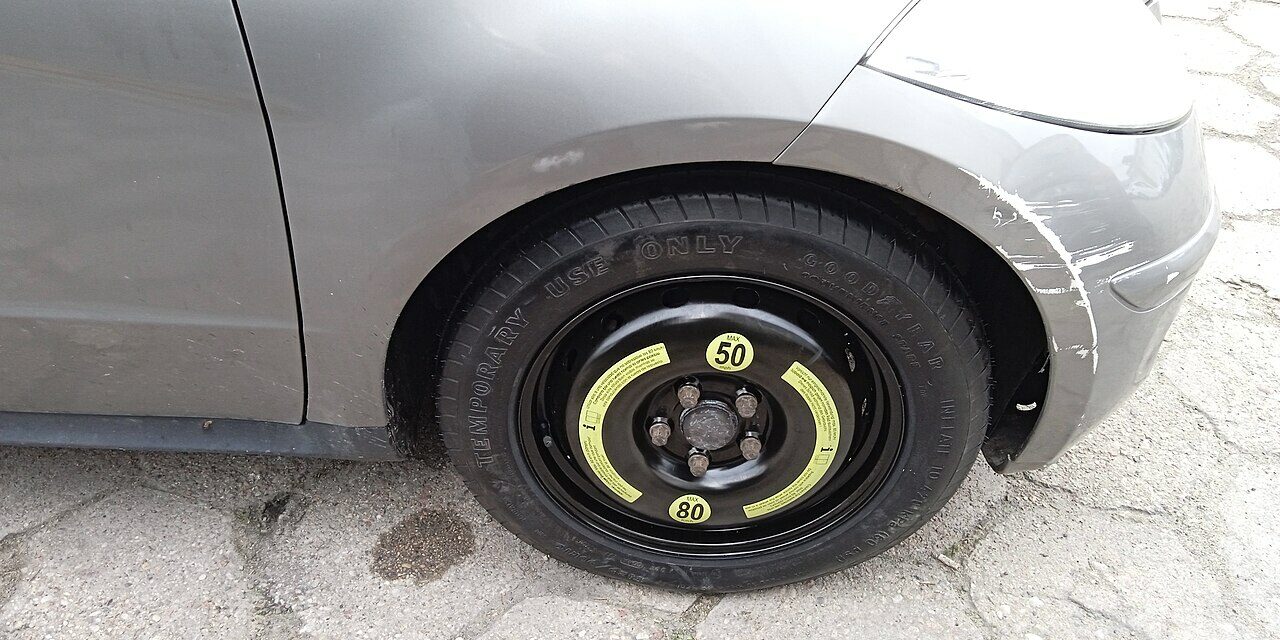
A space-saver is designed to get you to a tyre repairer, not to resume normal motoring. Its tyre and wheel are narrower than usual, and it normally carries a prominent maximum-speed label. The familiar limit is often 50mph, but use the limit printed on the tyre or wheel and the instructions for the vehicle. Keep the journey short, avoid high-speed driving and replace or repair the damaged road tyre promptly.
A space-saver also has a specified inflation pressure, often much higher than the road tyres. Check it with a gauge rather than relying on how it looks. Our guide to space-saver spare-wheel speed limits covers the temporary-use rules in more detail.
A compressor and tyre sealant kit
Many cars are supplied with a 12V compressor and a bottle of sealant instead of a wheel. This can be useful for a small puncture in the tread, but it is not a universal fix. It will not make a split sidewall safe, repair a badly damaged tyre or deal with a tyre that has come off its rim. If the tyre is visibly damaged, the car is unstable or you are stopped in an unsafe location, do not attempt a roadside repair.
Read the kit instructions before you need them. Sealant bottles have use-by dates, and the compressor may have a maximum running time. Some kits require the valve core to be removed; others do not. After using sealant, tell the tyre specialist, as it can affect whether a tyre can be inspected or repaired. The tyre-pressure-monitoring system may also need attention after a repair or replacement, depending on the car.
Run-flat tyres
A car on run-flat tyres may have no spare and no sealant kit. Run-flats are intended to be driven for a limited distance after a loss of pressure, but the permitted speed and distance depend on the tyre and vehicle. Do not guess from another model or a forum post: use the owner’s manual and the tyre-maker’s instructions. A run-flat can be badly damaged even when it does not look flat, so get it inspected as soon as possible.
No practical roadside solution
Some cars have an empty well or no useful storage at all. That does not automatically mean anything is missing. It may simply be how the car left the factory. It does mean that, after a puncture, recovery or mobile tyre assistance may be the only realistic route. If you regularly drive beyond easy reach of tyre services, consider whether an approved spare-wheel kit, a compatible compressor or roadside-assistance cover makes more sense for your journeys.
Five checks to make now
- Identify the system. Find the spare, repair kit or run-flat marking, then confirm it in the handbook.
- Check the pressure. A spare is useless if it is flat. Use the pressure shown for the spare, not the figure for the road tyres.
- Inspect the tyre. Look for cracks, bulges, cuts and obvious ageing. A spare can deteriorate while hidden in the boot.
- Account for every tool. You need the jack, wheel brace, locking-wheel-nut key and, where supplied, the wheel-bolt guide or removal hook.
- Read the sealant date. Replace an expired bottle with the correct type for the kit, not a random bottle that happens to fit in the boot.
Should you buy a spare-wheel kit?
There is no one-size-fits-all answer. A proper kit can be reassuring for rural journeys, late-night trips, towing or a car that cannot easily be recovered from where it is used. But it must be approved for the vehicle: wheel diameter, brake clearance, bolt pattern, load rating, tyre size and storage all matter. A poorly matched wheel can create a safety problem or fail to fit over the brakes.
Ask a main dealer or a reputable tyre specialist to confirm whether the manufacturer offers a compatible kit for your exact registration or VIN. Price the complete package, including the wheel, tyre, jack, brace, retaining bolt and storage solution. Do not assume a spare from another model will fit simply because the wheel diameter looks right.
What to do when the tyre goes down
Get to a safe place first. On a motorway, do not attempt a wheel change at the roadside: use an emergency area if you can reach one safely and contact your breakdown provider or National Highways. Elsewhere, avoid changing a wheel on soft ground, a slope or where passing traffic leaves no safe working space.
Once safe, use only the solution the vehicle is designed for. A space-saver is temporary, sealant has limits and a run-flat has a stated distance and speed allowance. After any temporary repair, arrange a professional inspection rather than treating the car as back to normal.
The useful answer before a long drive
Check the boot now, not on the hard shoulder. Know whether you have a full-size spare, a space-saver, a valid sealant kit, run-flats or no roadside option at all. Then make sure the equipment is inflated, in date and complete. That small bit of preparation is more useful than discovering a missing wheel brace when the weather has turned and the tyre is already flat.


Trackbacks/Pingbacks