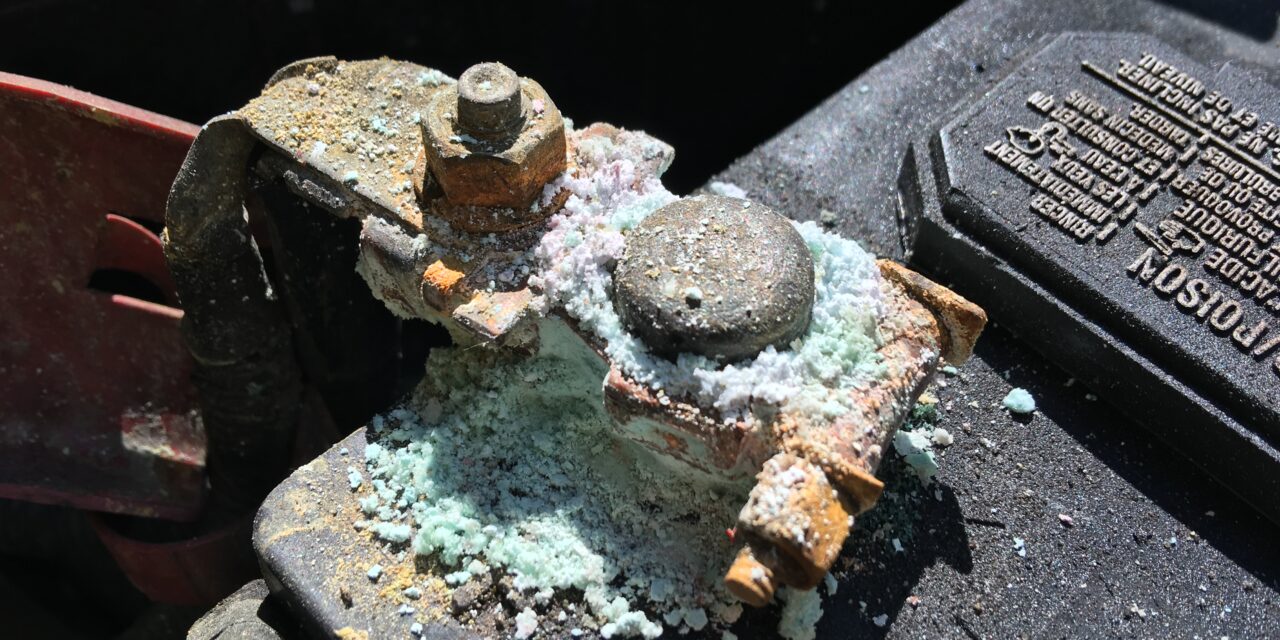
A chalky white, blue or greenish crust around a car battery terminal is easy to dismiss as cosmetic. It is not. Corrosion can increase electrical resistance at the connection, making starting and charging problems more likely, and it can be a clue that the battery, terminals or charging system need attention.
The good news is that terminal corrosion is often manageable. The important part is not merely making it look clean: it is dealing with it safely and finding out why it appeared. This guide is about the ordinary 12V starter battery found in petrol, diesel, hybrid and electric cars. It is not advice for touching any high-voltage hybrid or EV components.
First, decide whether you should drive or book help
A little dry powder around a battery terminal does not automatically mean the car is unsafe to move. But do not ignore it if there are signs of a failing connection or battery. Book a battery test or garage inspection promptly if:
- the engine cranks slowly, the lights dim when starting, or the car needs jump-starting
- the battery warning light stays on with the engine running
- you can smell sulphur or rotten eggs, see a swollen case, liquid, cracks or a hot battery
- the terminal clamp is loose, badly eaten away or will not tighten securely
- the corrosion returns quickly after it has been cleaned
In those cases, cleaning alone is not a repair. A leaking or damaged battery should not be handled as a routine DIY job. If the battery warning light remains on after the engine has started, remember that it can point to the charging system as well as the battery itself.
What causes the white powder?
Most conventional starter batteries are lead-acid units. Tiny amounts of acidic vapour, electrolyte residue or gas around the post can react with the terminal and nearby metal, leaving a pale deposit. Blue or green material is more likely around copper-containing parts. Road grime and dampness can make the area worse.
That does not mean every dusty-looking battery is failing. Age, a slightly loose clamp and normal chemical activity can all play a part. Repeated or heavy corrosion, however, is a reason to look beyond the visible mess. Possible underlying issues include a battery nearing the end of its life, a damaged seal or case, a poor connection, or a charging fault that is making the battery work outside its normal range.
How to clean battery-terminal corrosion safely
Only tackle light corrosion if you are comfortable working around a 12V battery and the battery case is intact. Check your vehicle handbook first: some cars have battery monitoring equipment, covers or specific disconnection instructions.
- Switch everything off. Park safely, switch off the ignition, remove the key or keep the key well away from keyless cars, and allow the engine bay to cool. Do not smoke or create sparks nearby.
- Protect yourself. Wear eye protection and gloves. Battery deposits can be irritating, and a lead-acid battery can contain corrosive electrolyte.
- Inspect before disconnecting. Stop if the battery is cracked, swollen, wet, hot or visibly leaking. Do not try to clean a damaged battery. Arrange professional help.
- Disconnect correctly. If the handbook permits disconnection, remove the negative terminal first, then the positive. Keep metal tools from bridging the two terminals or touching a terminal and nearby metalwork at the same time.
- Clean the connection, not the whole battery. Use a purpose-made battery-terminal cleaner or follow the battery or vehicle maker’s instructions. A terminal brush is useful for removing dry corrosion from the post and inside the clamp. Keep cleaning liquid out of the battery vents and away from painted surfaces and electronics.
- Dry and inspect. Wipe away residue, make sure the area is dry, and examine the clamp, cable and battery tray for damage. Replace a clamp that is cracked, badly corroded or unable to grip firmly.
- Reconnect in reverse order. Positive first, negative last, then secure any covers. Tighten only to the vehicle maker’s specification. Overtightening can damage a terminal or battery post.
Many people use household bicarbonate of soda to neutralise acidic residue. That can be effective when used carefully, but it is not a substitute for the vehicle maker’s procedure and it must not be allowed into battery cells or vents. If you are unsure, a garage or battery retailer can clean and test the system without the guesswork.
Do not confuse the 12V battery with an EV or hybrid battery
Hybrid and electric cars still normally have a conventional 12V battery for low-voltage systems, and that is the battery this advice concerns. Their high-voltage battery, orange cables and associated equipment are a different matter. Do not touch, disconnect or clean high-voltage components. If the affected part is not obviously the 12V battery, stop and use a qualified technician.
Why cleaning it once may not solve the problem
A clean terminal should make good electrical contact, but it cannot cure an exhausted battery or a fault in the charging system. If corrosion comes back, ask for a proper battery and charging-system test rather than buying a battery on appearance alone. The test should help distinguish between a weak battery, poor cable connection and a charging issue.
It is also worth checking the basics: is the battery physically secure, are the clamps tight, and is the battery the correct type for a car with stop-start or battery-management systems? Fitting the wrong specification can create problems even if the terminals look spotless.
Will battery-terminal corrosion fail an MOT?
The MOT does not grade a battery terminal for neatness. What matters is whether the battery is securely mounted and whether the electrical system presents an obvious safety issue. A loose battery, insecure hold-down or a visibly dangerous condition is more serious than a light deposit on an otherwise sound connection.
Do not use an MOT as the trigger for battery maintenance. GOV.UK says drivers are responsible for keeping a vehicle roadworthy throughout the year, even when it has a current MOT, and lists the battery among the items the handbook will tell you when to check. If the car is starting badly or the terminal is heavily corroded, deal with it now rather than waiting for test day.
A practical decision guide
- Small amount of dry corrosion, car starts normally: clean it carefully, ensure the clamp is secure, and keep an eye on it.
- Corrosion plus slow starting: clean the connection and arrange a battery and charging-system test soon.
- Corrosion that returns quickly: book a test. The underlying cause matters more than another clean.
- Leaking, swollen, hot or foul-smelling battery: do not attempt a home repair. Seek professional assistance.
- Hybrid or EV component is involved: only work around the clearly identified 12V system. Leave high-voltage equipment alone.
The bottom line
White powder on a car battery terminal is usually a small problem at the right moment and an expensive no-start at the wrong one. Clean light corrosion safely, make sure the connection is sound, and take repeat corrosion seriously. A quick battery and charging check is usually far better value than waiting for a cold morning to reveal that the visible crust was the least of the problem.
Useful official guidance: GOV.UK: check your vehicle is safe to drive.