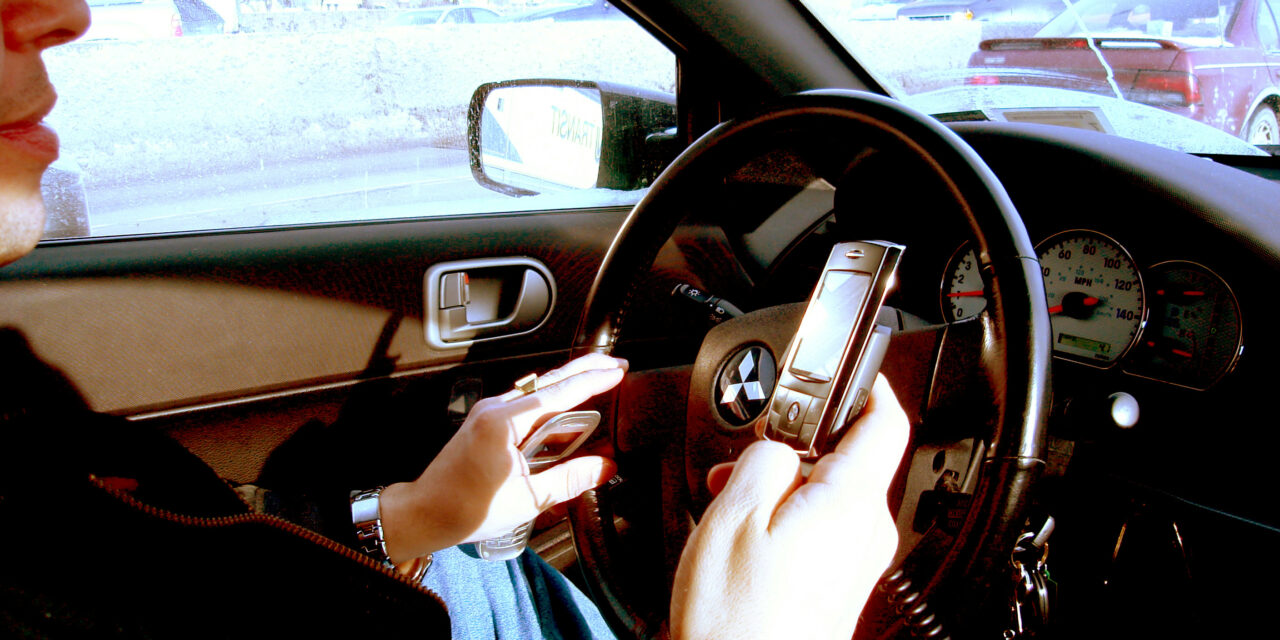
No. Stopping at red lights, sitting in a queue or letting a start-stop system cut the engine does not normally make it legal to pick up your phone. In Great Britain, the rule is about holding and using a device while driving, not simply whether the wheels are turning. That distinction catches people out because a car can feel parked when it is only temporarily stationary.
The sensible rule is simple: if you have not properly parked and finished the drive, leave the phone alone. Put it in a cradle before setting off, use a legitimate hands-free function only when it is safe, or wait until you are safely parked.
The rule at traffic lights and in traffic
GOV.UK says it is illegal to hold and use a phone, sat nav, tablet or other device that can send or receive data while driving. It specifically says the law still applies when you are stopped at traffic lights or queuing in traffic.
That includes apparently quick jobs: reading a notification, rejecting a call, changing a playlist, taking a photo, unlocking the screen or checking a map. Flight mode does not create a loophole. The Government guidance says the rule also applies to a device that is offline or in flight mode.
Do not rely on the engine being off either. The guidance expressly includes cars whose engines stop automatically when the vehicle stops. A red light is a pause in a journey, not a parking place.
What can the penalty be?
For holding and using a device while driving, the usual fixed penalty is six penalty points and a £200 fine. A driver who passed their test within the previous two years can lose their licence after reaching six points. More serious cases can go to court, where the consequences can be greater.
There is a separate, broader problem with distraction. Even where a phone is in a mount or the contact is hands-free, police can act if they believe you are not in proper control of the vehicle. The device being legal to mount does not turn a distracting conversation, screen or route search into good driving.
When may you hold the phone?
The exceptions are narrow. According to GOV.UK, you may use a handheld device:
- to call 999 or 112 in an emergency when it is unsafe or impractical to stop;
- when you are safely parked;
- to make a contactless payment in a vehicle that is not moving, such as at a drive-through restaurant; or
- to park a vehicle remotely.
Those examples matter because they show the difference between genuinely being parked and merely being stationary in the traffic stream. A drive-through payment is a listed exception. Browsing your phone while waiting at a set of lights is not.
What does ‘safely parked’ mean in practice?
Do not treat pulling to the kerb, stopping in a live lane or waiting in a traffic queue as safe parking. Find a lawful place to stop, secure the vehicle and finish the driving task before using the phone. If there is any doubt, wait.
That approach is also better for safety. A glance at a screen can be followed by a vehicle ahead moving, a pedestrian stepping out or a cyclist filtering past. The issue is not only the risk of a ticket but the attention taken away at exactly the moment the road scene can change.
Are hands-free calls allowed?
Hands-free access is permitted provided you do not hold the device at any point. GOV.UK lists Bluetooth, voice command, a dashboard holder or mat, a windscreen mount and a built-in sat nav as examples. The device must not block your view of the road and traffic ahead.
But ‘hands-free’ is not a blanket permission to operate a phone however you like. Set the destination before moving, keep the screen out of the main sightline and use voice controls sparingly. If a call, notification or map problem needs your full attention, pull over safely first. For mounting position, see Motoring Mojo’s guide to where a phone holder can go legally.
Common situations, answered
Can I check a message at red lights?
No. You are still driving for the purpose of the handheld-device law, even though the car is stopped.
Can I use my phone while waiting in a traffic jam?
No. Queuing in traffic is specifically covered by the Government guidance.
Can I pay with my phone at a drive-through?
Yes, provided the vehicle is not moving. Contactless payment at a drive-through is one of the stated exceptions. Put the phone away immediately afterwards and do not use the exception as a reason to keep browsing.
Can I change a route on a phone in a cradle?
A mounted phone is not handheld, but changing a route while moving can still mean you are distracted or not in proper control. Pull over safely if it needs more than a quick voice instruction.
Can a supervising driver use a phone?
No. The handheld-device rules can apply when supervising a learner driver. The supervising adult has an active role and should treat the phone restriction seriously.
A safer routine before every journey
- Put the phone in a secure mount or out of reach before moving off.
- Set navigation, music and any hands-free connection while parked.
- Turn on a driving focus or do-not-disturb mode if your phone offers one.
- If something cannot wait, find somewhere lawful and safe to park rather than using a red light as an opportunity.
It is a small habit, but it removes a costly and avoidable risk. Traffic lights and queues are still part of the drive. Treat them that way.