Public charging is easier than its reputation suggests, but the first stop can feel needlessly high-stakes. There may be several cables, different prices, a queue and a screen asking for payment before you are sure what plugs into what.
The useful approach is not to memorise every network. It is to make a few checks in the right order: find a charger your car can use, read the price and parking terms, follow the instructions on that unit, and move on once you have enough energy. Here is the practical UK routine.
Before you leave: know three things about your car
Look in the car handbook or its app for the charging-port type, the maximum rapid-charging rate and the location of the port. On most newer UK EVs, rapid charging uses a CCS connector; many older Nissan Leafs use CHAdeMO. For slower AC charging, Type 2 is common. Do not assume a socket that looks familiar is the right one for your car.
Your car also sets a ceiling on how fast it can charge. A 150kW or 350kW unit will not make a car capable of 50kW charge at 150kW. Battery temperature and state of charge can reduce the rate too, particularly when the battery is cold or already quite full. Choose the speed you need for the journey, rather than paying for the biggest number on the totem.
For a first long trip, it is sensible to have a second nearby charging location in mind. A live charging map can show connector types, reported availability and amenities, but it is still worth checking the chargepoint screen and the bay signs when you arrive.
At the site, read the bay before you park
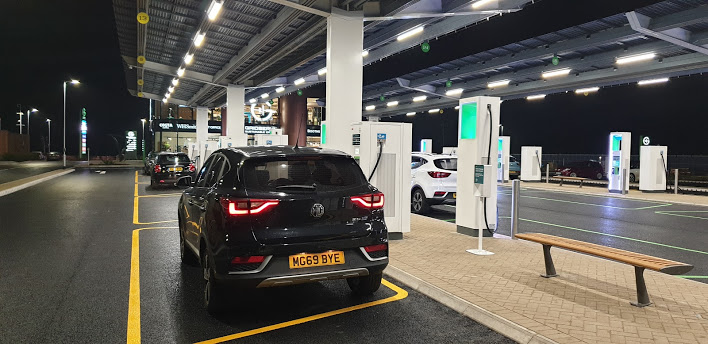
Charging bays are parking spaces with extra conditions, not simply reserved spaces. Check the signs for the operator, any maximum stay, whether the bay is for charging only, and whether the car park has a separate parking tariff or validation rule. A charger can be working while the bay has a time limit.
Park so the cable reaches without being stretched across another space or a walking route. If the charger has a tethered cable, use that cable rather than trying to force your own. If it is untethered, take out your Type 2 cable only when the charger and car both call for it.
Before connecting, inspect the cable and connector. Do not use damaged equipment, exposed pins or a cable that will not latch cleanly. If anything looks unsafe, choose another unit and report it to the operator.
Check the price before you start
Prices can vary sharply between locations and speeds, and the unit rate is only part of the bill. Look for the pence-per-kWh price, any connection or minimum charge, and any overstay fee once charging has finished. A high-powered unit can be the right choice for a motorway stop, but a slower destination charger may make more sense if you will be parked for a while.
UK rules require the maximum session price to be displayed clearly in pence per kWh, either at the chargepoint or through a separate device that does not require a contract with the operator. The advertised price must not rise once charging has started. The government's Public Charge Point Regulations guidance also sets requirements for payment, reliability and helplines.
Do not confuse the price per kWh with the charging rate in kW. The first is what the energy costs. The second is the speed at which the car can take it. If the screen gives a final estimate or asks you to accept a tariff, read it before confirming.
Starting the charge: let the screen lead
There is no universal button order, so follow the instructions on the individual charger. Usually you will select the connector or payment method, plug in when prompted, and wait for the car and charger to complete their safety checks. Some units ask you to plug in first. Others ask for a card, app or RFID tap before the connector is released.
On newer public chargepoints rated at 8kW and above, and on existing public units rated at 50kW and above, contactless payment is generally required under the regulations. That does not mean every slower or older charger will take a bank card, so keeping the relevant network app or an RFID card available can still save time. An operator should provide a free, staffed 24-hour helpline number at the chargepoint if you get stuck.
Once the session begins, check the car or screen shows that energy is actually flowing. A cable being locked into the car is not proof that charging has started. Confirm the rate is plausible, then return after a few minutes if the car allows remote status checks.
How much should you add?
On a longer journey, charge for the next leg with a sensible buffer rather than automatically aiming for 100%. EV batteries commonly charge more slowly as they approach full, so the last part can take disproportionately long. The best stopping point depends on the route, weather, your car's real-world consumption and the next reliable charger.
For destination charging, the calculation is different. If the car will be there for several hours and the bay permits it, slower charging may be entirely appropriate. Just set a reminder to move it when the session ends if an overstay fee or a bay time limit applies.
Finishing properly matters too
End the session on the charger, app or car as instructed. Unlock the car if necessary, remove the connector without forcing it, return a tethered cable neatly to its holster and make sure the charge flap is closed. Check that the session has ended before driving away.
Then free the bay promptly. Staying in an EV bay after charging has finished can inconvenience another driver and may breach the terms displayed at the site. If the unit fails, take a photo of the error code and the charger number, use the helpline, and keep any receipt or app record if payment needs to be queried later.
A five-point first-charge checklist
- Compatibility: check the connector and the charger's power before you divert.
- Bay rules: read the signs for charging-only, parking and time-limit conditions.
- Price: look for the pence-per-kWh rate and any idle, connection or parking charges.
- Proof: after starting, confirm that the car is receiving power rather than merely plugged in.
- Exit: end the session, stow the cable and move on when you have what you need.
The first public charge is mostly about replacing guesswork with a routine. Once you have used one or two different networks, the screens and connectors stop feeling like a test. For more on the cost side, read our guide to charging an electric car in the UK, and if you are using a marked bay, see the rules around EV charging bay parking.