
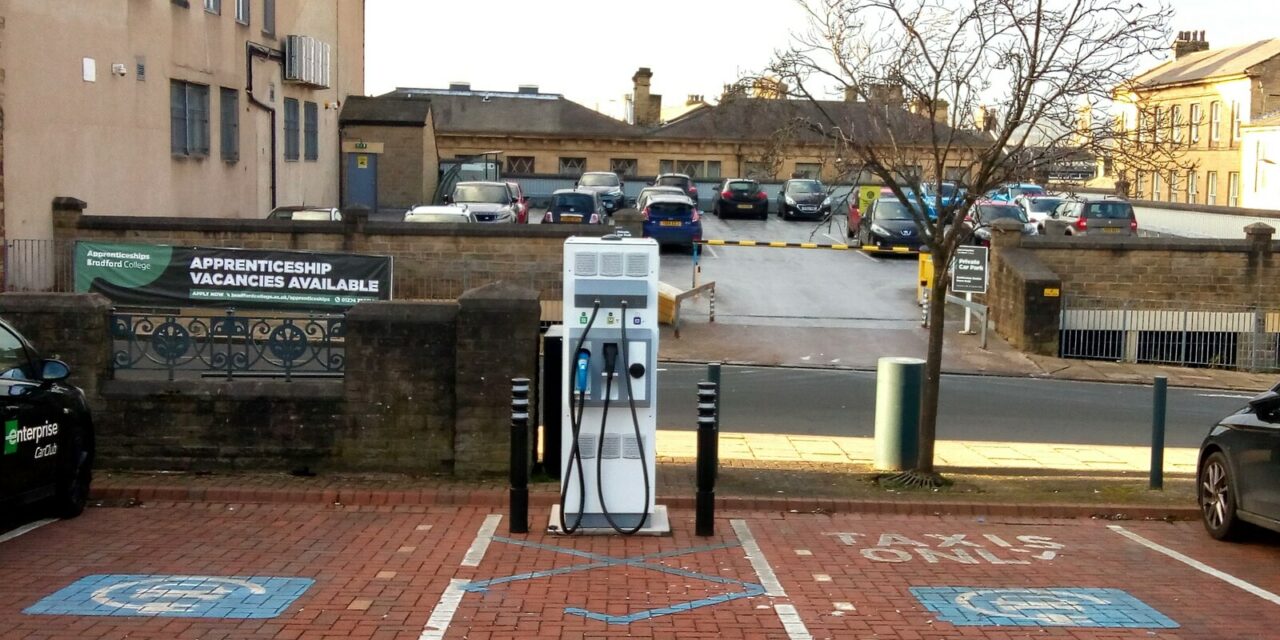
Can you park in an EV charging bay without charging? Sometimes the answer is no, sometimes it is no unless you are actively charging, and occasionally the restriction may be narrower than drivers assume. What matters is not the blue paint or the charging post on its own. It is the sign, the bay markings and, on a public road, the local traffic order behind them.
That is why treating every electric-vehicle bay as ordinary parking is a bad bet. A non-EV parked there can deny a driver a charge. An EV left there after charging can do much the same. Either can trigger enforcement where the stated terms prohibit it.
Start with the sign, not the colour of the bay
Read every line on the nearby sign before leaving the car. It may say that the bay is:
- for electric vehicles only;
- for electric vehicles while charging only;
- available only during stated hours;
- limited to a maximum stay, including while connected;
- subject to payment, registration in an app or a parking session; or
- controlled by the operator of a private car park.
Those are importantly different rules. “Electric vehicles only” might permit an EV to occupy the bay without taking a charge, if no other condition is shown. “While charging” is more restrictive: plugging in but not starting a session may not meet the condition, and staying after the session ends may not either. Do not invent a grace period because the charger has stopped. If the sign gives one, it will normally say so.
The Department for Transport’s Traffic Signs Manual and the Traffic Signs Regulations and General Directions set the framework for parking signs on the road. In practice, the wording at the location is the quickest and most useful answer for the driver standing there.
On-street bays: the council’s restriction is what counts
For an EV bay on a public street, a council normally uses its parking powers and a traffic order to create the restriction. The sign and road markings tell drivers how that restriction applies on the ground. If the bay is reserved for a class of user and you are not entitled to use it, enforcement can lead to a penalty charge notice.
The Highway Code is blunt on the general principle: drivers must not park in spaces reserved for specified users unless they are entitled to do so. An EV bay with a condition is not a loophole just because the road has no yellow lines.
Take a clear photo of the sign and bay if anything is unclear, especially if it is obscured, damaged or appears inconsistent with the marking. That is sensible evidence if a penalty is issued. It does not make the bay available to use, so the safest choice when the restriction cannot be read is to find another space.
Private car parks work differently, but the terms still matter
At supermarkets, stations, retail parks, hotels and workplaces, the operator’s signs set the conditions of parking. The possible consequence is usually a private parking charge rather than a council penalty charge notice. They are not the same thing, but neither should be ignored.
Look for signs at the entrance and beside the charger. Some operators reserve the bay for vehicles charging, some allow a defined charging-and-parking period, and some run a separate charger tariff after a short free period. The charger app may show the electricity price but not the car park’s parking terms. Check both.
Do not assume that having an EV makes the bay yours, or that being connected makes any length of stay acceptable. The sign may require active charging, a valid parking session or departure within a set time. If you need to shop, eat or catch a train for longer than the stated limit, move the car when charging is complete.
Four situations drivers regularly get wrong
1. “I only need five minutes”
A short stop can still breach a restriction. There is no UK-wide five-minute permission for an ordinary petrol or diesel car to wait in an EV bay, and a short wait by an EV can also fall outside a “while charging” condition.
2. “My EV is plugged in, so I can leave it all day”
Not necessarily. Charging equipment may stop at the chosen limit, at the end of a timed session or when the battery is full. A maximum-stay sign still applies. Some networks also apply an overstay fee under their own charging terms, separate from any parking enforcement.
3. “The charger is broken, so the bay is just parking”
It might not be. A broken chargepoint does not automatically cancel the parking restriction. If the terms require charging and you cannot charge, use another bay unless the operator or council provides an alternative instruction. Report the fault through the number or app shown on the unit.
4. “There are no signs, only an EV symbol painted on the ground”
That is a reason to be cautious, not a reason to presume permission. Look for an upright sign nearby and check the wider car-park signs. If you cannot establish the terms, park elsewhere. The minor inconvenience is cheaper than a dispute and more considerate to drivers who need the point.
A quick check before you leave the car
- Is the bay on a public road or private land?
- Does the sign say EV only, charging only, or both?
- Are there operating hours, a maximum stay or a payment requirement?
- Has your charging session actually started?
- Will you be back before charging ends or the time limit expires?
- Have you checked the car-park sign as well as the charger app?
One final practical point: when charging, park close enough that cables do not create a hazard and put them away afterwards. The Highway Code specifically advises drivers to avoid trailing-cable trip hazards at chargepoints.
The sensible rule
Use an EV charging bay for its stated purpose, for no longer than its stated terms allow. For a non-EV, that almost always means choosing another space. For an EV, it means reading whether the bay is for electric vehicles generally or for active charging, then moving on promptly once the job is done. It is the clearest way to avoid a ticket, a charge or an unnecessary argument at the charger.





Trackbacks/Pingbacks