Finding a public charger is one thing. Finding out how to pay for it, and what it will actually cost, can still be the awkward part. The good news is that the UK’s Public Charge Point Regulations set some useful minimum standards. The less convenient news is that they do not mean every charger has to have a card reader.
Here is the practical version for drivers: when you should be able to tap a bank card, when an app may still be normal, and the checks worth making before you plug in.
The short answer
At a new public charger rated at 8kW or more, deployed from 24 November 2024, contactless payment should be available. So should it at an existing public charger rated at 50kW or more. The requirement applies to paid-for charging, and contactless must be available without requiring a pre-existing contract or account with that operator.
That does not necessarily mean a card reader on every individual unit. At a multi-charger site, a nearby terminal can serve the site if it is genuinely close enough and clearly usable. The terminal must accept contactless bank cards, although it can also accept Apple Pay or Google Pay.
A slower charger below 8kW, or an older 8kW to 49kW charger, may still ask you to use an app, RFID card, web payment page or another method. Free public chargers are outside the contactless requirement until they begin charging users.
Do not confuse a payment app with a legal requirement
Apps can be useful. They may show a charger’s live status, start a session, retain receipts or unlock a member price. But at a charger covered by the contactless rule, the operator cannot make you download its app or open an account simply to pay on an ad-hoc basis.
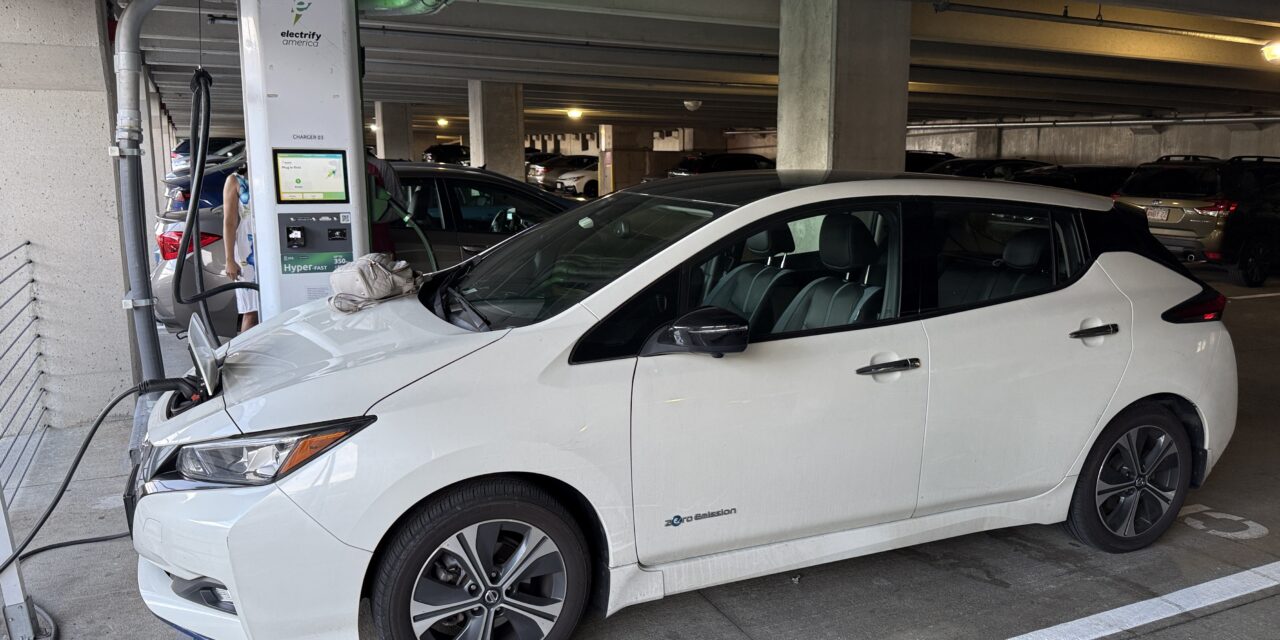
If you are at a qualifying rapid charger and the only obvious route is an app, look around for a shared payment terminal. Some sites put it beside the bays, on the charger island or in an attached service-station building. A terminal in a building that is shut while the chargers are available is not a workable substitute.
There is a separate reason not to rely on one network’s app: reception can be patchy in car parks and rural locations. A contactless card, or a phone wallet with a physical card as backup, is a sensible part of an EV long-trip kit.
The price should be visible before you start
For public charge points, the maximum price for the charging session must be displayed clearly in pence per kilowatt hour or pounds per kilowatt hour before charging starts. It can be shown on the charger or on a separate device, but you should not need an existing contract with the operator merely to see it.
This matters because the tariff on the big screen is not always the whole story unless you read it properly. Connection, transaction and other fixed charging fees must be included in the maximum pence-per-kWh price presented to the driver. A separate parking charge imposed by a car-park operator is different, so check the parking signs as well as the charger screen.
Off-peak or dynamic pricing is allowed. The key protection is that the price you pay cannot exceed the maximum price shown to you before the session begins. If an app gives subscribers a different price, it should make clear both the applicable pence-per-kWh price and any remaining discounted allowance.
Four checks before you connect
- Check the power rating. A 50kW rapid unit should have contactless available. A new 8kW-plus public unit should too. Do not assume that every slower destination charger has the same rule.
- Read the price and the parking terms separately. Note the pence-per-kWh maximum, any idle fee and the car park’s time limit. Charging can be compliant while a parking overstay still costs you.
- Look for the support number. Public chargers should display a free-to-use, staffed 24/7 telephone helpline. Photograph the unit number and any error message before calling.
- Keep a record if payment or pricing goes wrong. Take screenshots of the app, photos of the tariff and terminal, and retain the bank transaction or receipt. It makes a refund request much easier to assess.
What about reliability?
The rules also require rapid charge-point networks to achieve 99% reliability, measured across an operator’s network over a calendar year. That is a network-wide measure, not a promise that every connector will work on every visit. It is still useful: operators must publish reliability information on their websites, so it can help when choosing between networks before a long journey.
Charge-point operators also have open-data obligations intended to make location and availability information easier to share. A map or car navigation system is a good starting point, but it is wise to have a second nearby charging option in mind when the battery is low.
If the charger does not meet the standard
Start with the operator’s 24/7 helpline and ask it to log the problem. Be specific: say whether the card terminal was absent, unavailable or too far from the bay, whether the displayed price was unclear, and whether you were prevented from charging.
If you are charged incorrectly, complain to the operator first and attach your evidence. For an unresolved issue about a regulatory requirement, the enforcement authority is the Office for Product Safety and Standards. The government’s Public Charge Point Regulations guidance sets out the scope of the rules and the standards operators must meet.
Do not let a payment dispute tempt you to leave a car in a bay beyond the site’s rules. If you cannot start a charge and need to move on, take the evidence first and find another charger. Our guide to EV charging-bay parking rules explains why a plugged-in car can still fall foul of the signs.
The useful bottom line
For the chargers most likely to matter on a long journey, card payment should now be the normal fallback rather than an optional extra. It does not replace apps, memberships or route planning, but it means a driver should not be stranded by a missing login at a new 8kW-plus public charger or any public 50kW-plus unit.
Before you connect, check the price, the parking terms and the payment terminal. That thirty-second pause is usually cheaper than discovering an idle fee, a separate car-park charge or an app problem after the battery is already low.