Do not assume an automatic car can be towed simply because it will roll in neutral. Some can be moved for a short distance in tightly defined circumstances; others should be carried with every wheel off the road. The right answer is in the handbook for that exact model, not in a general rule about automatic gearboxes.
That matters because an automatic transmission, dual-clutch gearbox, CVT, hybrid drive system or electronic parking brake may be damaged if the driven wheels turn while the car is being towed. A rope, tow bar or recovery truck with the wrong setup can turn a breakdown into a much larger repair bill.
For a stranded driver, the safest working assumption is straightforward: call a recovery provider, say the car is automatic, give the exact make and model, and ask it to use the manufacturer-approved recovery method. If nobody can confirm that method at the roadside, a flatbed is usually the low-risk option.
Why neutral is not a blanket permission to tow
Neutral disconnects engine drive in the normal driving sense. It does not necessarily make every internal part of an automatic transmission safe to spin with the engine off. On some designs, transmission lubrication depends on an engine-driven pump. On others, the issue may be the parking mechanism, an electric motor, the layout of the driven axle or a model-specific emergency release procedure.
That is why advice such as “put it in N and keep the speed down” is not good enough on its own. A particular handbook may allow a limited-distance, limited-speed tow with the engine running, or it may prohibit wheels-on-the-ground towing altogether. Both answers can be correct for different cars.
Do not try to infer the answer from the badge, the age of the car or the type of selector. A conventional torque-converter automatic, a DSG-style dual-clutch gearbox, a CVT, a hybrid and a battery-electric car are not interchangeable for recovery purposes.
The recovery method to ask for
There are several ways a non-running car can be moved. The suitable one depends on the vehicle maker’s instructions.
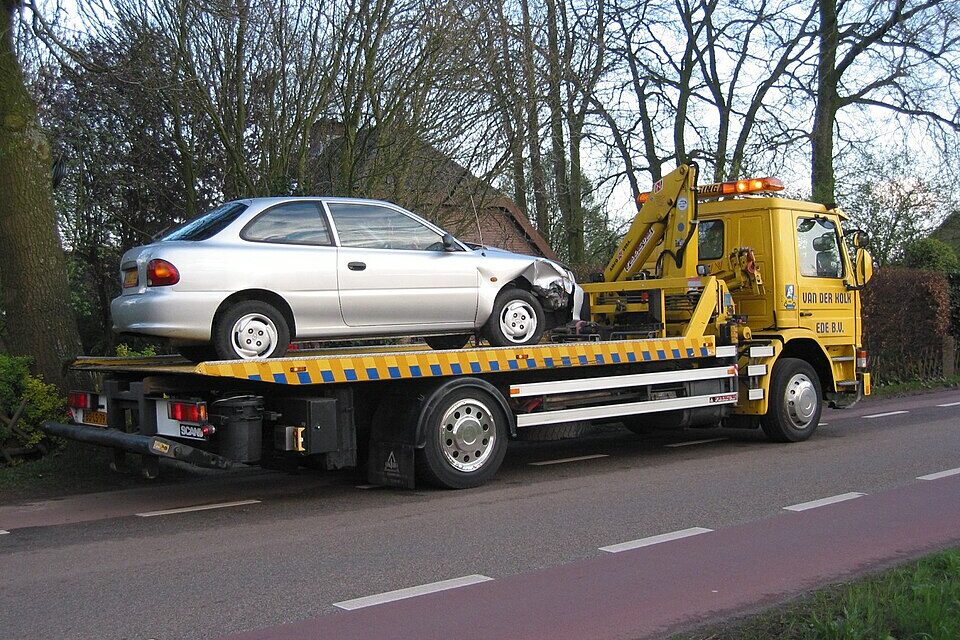
- Flatbed or transporter: the whole car is carried. This avoids turning the road wheels and is the most broadly suitable option when the approved method is unknown.
- Wheel lift with dollies: one end is lifted and the other wheels are supported on small wheeled dollies. This can be appropriate where the recovery procedure allows it.
- Rope or rigid-bar tow: this leaves the car’s wheels on the road. It should only be considered when the handbook specifically permits it and the recovery operator is satisfied it is safe and lawful in the circumstances.
A flatbed is not a claim that every automatic must be transported that way. It is a sensible default when the gearbox condition is unknown, the car cannot select neutral, the electronic parking brake will not release, there has been collision damage, or no one can verify the vehicle-specific instructions.
What to tell the recovery operator
Give useful facts at the first call, not after a truck has arrived:
- Make, model, registration and approximate year.
- That it is automatic, plus whether it is a hybrid, plug-in hybrid or fully electric.
- What has failed: engine will not start, gearbox warning, flat 12V battery, puncture, collision damage or something else.
- Whether the car can be put into neutral and whether all four wheels turn freely. Do not force either point to make collection easier.
- Whether it is on a slope, in a tight car park, underground, in floodwater or on a fast road.
If it is safe to do so, find the handbook’s “towing”, “recovery” or “transporting the vehicle” section while you wait. A digital handbook on the manufacturer’s website can help, but use the one for the precise model and model year. Passing the relevant instruction to the operator is much more useful than relying on a forum post or a similar-looking car.
Do not improvise with the towing eye
Many cars have a screw-in towing eye behind a small bumper cover. Its presence does not prove the car can be towed long-distance with its wheels on the road. It may be intended only to pull the car a short distance onto a transporter, out of a dangerous position or around a workshop.
Likewise, selecting N can have conditions attached. Some cars need the ignition on, a key present, a particular sequence, a live 12V system or a manual emergency release. If the car has suffered a collision, the normal procedure may no longer be appropriate. Never crawl underneath a stranded car to look for a release, and never let a recovery crew attach to a random suspension or steering part.
Automatic, hybrid and EV: why the difference matters
Hybrid and electric cars deserve an extra pause before recovery. Their systems may use a parking pawl, electric motors and software-controlled neutral modes that are unlike a petrol automatic. Turning the driven wheels can rotate an electric motor, while a flat 12V battery can prevent the car from releasing systems needed for loading.
For an EV, hybrid or plug-in hybrid, tell the provider what it is before it dispatches a vehicle. Mention any underside impact, floodwater, smoke, heat, hissing, warning messages or inability to shift. A damaged high-voltage vehicle is not a situation for a private rope tow or a home-made workaround.
If the car has broken down on a motorway
Recovery method comes after safety. The Highway Code’s breakdown guidance says to aim for a place of relative safety, use hazard warning lights if the vehicle is causing an obstruction and contact a recovery service. On a motorway or other high-speed road, a service area is safest where it can be reached; a hard shoulder offers less protection because it remains close to fast-moving traffic.
If you stop in an emergency area or on a hard shoulder and can leave safely, keep well behind the barrier where there is one. Do not attempt roadside repairs, do not put a warning triangle on a motorway carriageway and do not return to the car just because the weather is unpleasant. If you cannot exit safely, call 999 or use the vehicle’s SOS function where fitted.
The RAC’s breakdown guidance also stresses reaching a safe location and seeking assistance rather than trying to fix a vehicle beside fast traffic. Once you and your passengers are safe, let the recovery company decide how to load the car.
A five-minute check worth doing before a trip
You do not need to wait for a breakdown to find out how your automatic should be recovered. Search the handbook now and save the relevant page or take a photo of it. Check where the towing eye is stored, whether the car has a specified transport mode and which number to call for roadside assistance.
This is particularly useful before a long holiday trip, after buying a used automatic, or if the car has a known weak 12V battery. It also lets you check that your breakdown cover is suitable for the vehicle, including onward recovery if a specialist repairer is required.
The bottom line
Yes, some automatic cars can be towed, but only in the way and within the limits their manufacturer permits. Neutral does not settle the question. Do not use a rope or rigid bar because a car appears to roll: tell the recovery operator the exact vehicle, follow the handbook and choose a flatbed when the approved method cannot be confirmed.