
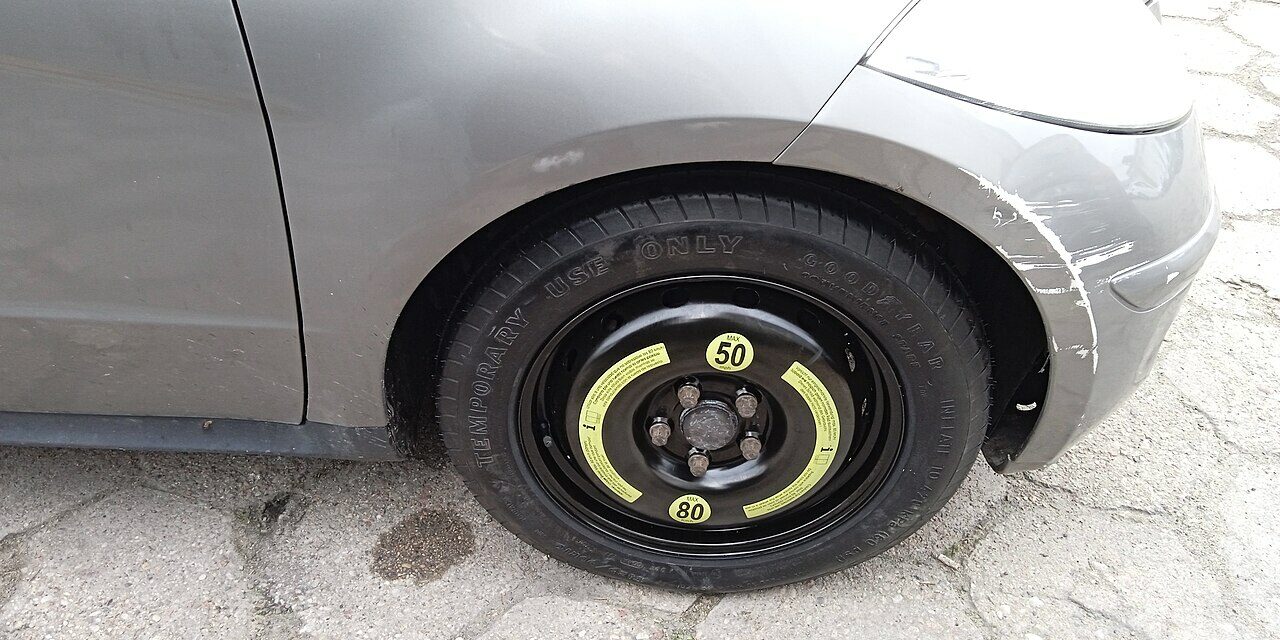
A puncture is annoying enough without discovering your spare wheel is not really a normal wheel at all.
Many UK drivers only look at the space saver for the first time when they are stuck at the roadside. That is when the obvious questions start. Can you use it on a motorway? Is 50mph a legal limit or just advice? How far can you drive before you need a proper repair?
The short answer is this: a temporary use spare tyre is legally allowed in the UK, but if you drive above 50mph you are outside the exemption written into the Construction and Use Regulations. It is there to get you to a place of repair, not to carry on as normal.
The key rule in the UK
Under Regulation 26 of the Road Vehicles (Construction and Use) Regulations 1986, a temporary use spare tyre is allowed on a passenger vehicle even though it does not match the normal tyres on the axle, but only if the vehicle is not driven at more than 50mph.
That matters because normal rules say tyres on the same axle must match by structure. The law makes a specific exception for a temporary use spare. It does not give you a free pass to drive normally for the rest of the week.
So if your car is on a space saver, the safest working rule is simple:
- keep below 50mph
- drive only as far as you need to reach a tyre specialist or safe destination
- avoid treating it as an ordinary road wheel
Is 50mph advice or law?
For a space saver, 50mph is more than a casual recommendation.
The legal wording behind the temporary spare exemption hinges on the vehicle not being driven above 50mph. That is why breakdown firms and tyre safety organisations repeat the same figure so consistently.
You may also see a speed warning sticker on the wheel itself. Follow that too. If the wheel or handbook sets a lower limit, use the lower one.
Can you drive on a motorway with a space saver?
Usually yes, but only if you can stay within the spare wheel’s limits and the car still feels stable.
There is no separate UK motorway ban on using a space saver. The real issue is whether motorway driving makes sense when you should be keeping below 50mph, accelerating gently and allowing for longer braking distances.
If traffic is flowing quickly, staying on a motorway with a temporary spare can leave you feeling exposed. In practice, the sensible move is often to leave at the next safe exit and head to a tyre fitter by slower roads if that is realistic.
If the puncture happens on a smart motorway or hard shoulder access is unsafe, personal safety comes first. Use breakdown support if you need it.
How far can you drive on a space saver spare wheel?
This is where drivers get mixed messages.
There is no single hard legal distance in UK law. But that does not mean the distance is unlimited.
The AA says there is no maximum distance written into the rules, while stressing that the restricted speed, shallow tread and softer compound mean the journey should not be excessive. TyreSafe goes further with a practical recommendation of no more than 50 miles on a space saver before repair or replacement.
That is a good real-world benchmark. If the tyre shop is 8 miles away, fine. If you are planning to keep driving for several days because the car still moves, that is the wrong approach.
Why space savers are so limited
A space saver is smaller and narrower than the regular wheel and tyre it replaces. That helps save boot space and weight, but it changes how the car behaves.
Expect:
- less grip than the standard tyre
- altered braking performance
- less stable cornering
- more caution needed in heavy rain
- a car that may pull or feel unusual at speed
This is also why towing, long-distance driving and spirited driving are bad ideas on a space saver.
If the puncture is on the front, do not always fit the spare there
This catches a lot of people out.
TyreSafe advises that on a front-wheel-drive car, if a front tyre is punctured, you should usually move the rear wheel on the same side to the front and fit the space saver to the rear. That is done for safety, because a temporary spare on the front axle can affect steering and braking more noticeably.
That said, your vehicle handbook matters here. Some cars have specific instructions about whether the spare can be used on the front axle, rear axle, or both.
If you are not sure, check the handbook or call breakdown assistance rather than guessing.
Can you keep using a space saver until the MOT?
No. That is asking for trouble.
TyreSafe is clear that a car will not pass its MOT if a space saver is fitted as a normal road wheel. It is a temporary emergency solution, not a permanent replacement.
Even before MOT time, continuing to use one for day-to-day driving is a poor bet because you are deliberately driving around on a tyre with known limits.
What about a full-size spare?
A full-size spare is different.
If it is the correct size and specification for the car, and it is in good condition with legal tread depth, you can generally use it like any other normal tyre. The special 50mph rule is about temporary use spare tyres, not proper full-size replacements.
That said, if your full-size spare is old, cracked, underinflated or a different specification from what the car needs, it is not a free pass either.
When should you stop and call for help instead?
Do not carry on driving just because the spare is fitted. Stop and get help if:
- the spare looks underinflated or damaged
- the car feels unstable, noisy or hard to steer
- you are already close to the 50mph traffic flow of a fast road and do not feel safe
- more than one tyre is damaged
- the handbook says the spare cannot be used in your current wheel position
- you are towing or carrying a very heavy load
If in doubt, the cheapest decision is not always the safest one.
The practical UK checklist after fitting a space saver
If you have fitted a space saver and need to continue your journey, this is the sensible order of play:
- Check the spare’s condition and inflation as far as you can.
- Read any speed warning shown on the wheel.
- Keep your speed below 50mph.
- Drive smoothly with bigger gaps for braking.
- Avoid long motorway stretches if a safer slower route is available.
- Book a puncture repair or replacement as soon as possible.
- Swap back to a proper road wheel at the earliest chance.
The bottom line
A space saver spare wheel is legal in the UK as an emergency measure, but it is not a normal tyre and it is not meant for normal driving.
If you remember just three things, make them these: keep under 50mph, keep the journey short, and get the proper tyre repaired or replaced quickly.
That is the difference between using the spare as intended and turning one puncture into a bigger problem.




Trackbacks/Pingbacks