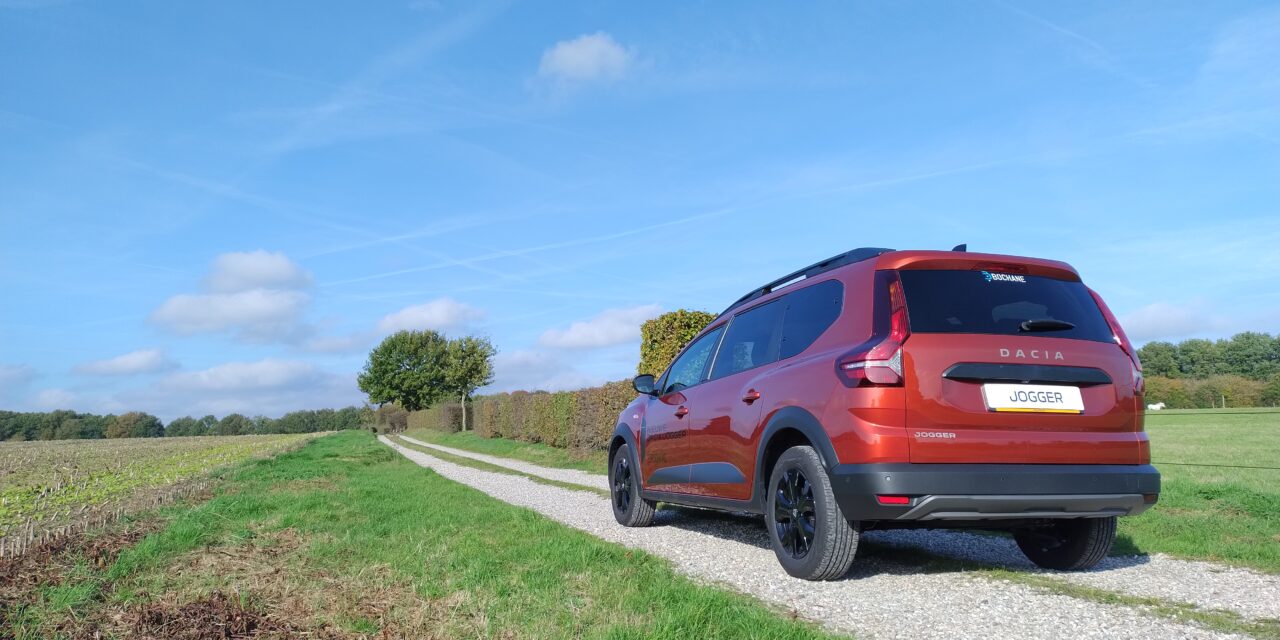
If you need seven seats but do not want seven-seat SUV prices, the used Dacia Jogger deserves a proper look.
It is one of the few cars that can carry a larger family without immediately pushing you into a much heavier, much dearer used SUV. That matters in the UK, where buyers often end up choosing between cramped third rows, inflated badges and monthly payments that drift far beyond the original plan.
The Jogger works because it is honest about what it is. It is not a luxury car. It is not trying to be a prestige SUV. It is a long, practical family car with standard seven-seat capability, useful cabin flexibility and running costs that can still make sense for ordinary households.
The trick is buying the right one.
The short version
- The Dacia Jogger makes sense because every UK car gets seven seats as standard, and official Dacia figures quote up to 2,085 litres of maximum boot space.
- With all seven seats in use, boot space is much tighter at 160dm3 VDA or 212 litres, so you need to be realistic about luggage.
- For most budget-minded buyers, the 1.0 TCe 110 manual is the simple place to start.
- If you do a lot of town driving or strongly prefer an automatic, the hybrid is worth the extra attention.
- Expression is the trim that usually looks like the sweet spot, because it adds genuinely useful family kit rather than cosmetic extras alone.
- Euro NCAP gave the Jogger a one-star overall rating, but the detail matters more than the headline.
- The GOV.UK vehicle recall checker currently shows no recalls for Dacia Jogger model years 2022, 2023, 2024, 2025 or 2026.
Why the used Jogger is worth bothering with at all
A lot of cars claim to be practical. The Jogger is practical in a way that changes what you can buy for the money.
Dacia’s own UK brochure pitches it as a seven-seat SUV estate and backs that up with the numbers that matter. Official dimensions show a 4,550mm length, seven seats as standard and several boot configurations. In seven-seat form, Dacia quotes 160dm3 VDA or 212 litres with all seats up, 565dm3 VDA or 699 litres with the third row folded, 696dm3 VDA or 820 litres with the third row removed, and up to 1,807dm3 VDA or 2,085 litres at maximum load volume.
That is the real selling point. The Jogger gives family-car space without forcing you into a physically larger, more expensive SUV. Parkers is broadly on the same page, calling it incredibly spacious for its size and pointing out that you simply do not get seven adult-size seats in many similarly priced alternatives.
If you are cross-shopping used Nissan X-Trails, Peugeot 5008s or larger SUVs simply because you need occasional extra seats, the Jogger can be the much cheaper reality check.
Start by deciding how often you really need seat six and seat seven
This is the question that should shape the whole search.
If you genuinely use the third row every week, the Jogger has a strong case because seven seats are part of the basic package rather than an expensive upgrade. Dacia also says the seven-seat version uses two independently folding and removable third-row seats, which is useful for buyers who want flexibility rather than a fixed layout.
But you should not buy one blindly on brochure logic. When all seven seats are occupied, luggage space is modest. That does not make the Jogger a bad family car. It just means you need to think honestly about your real pattern of use.
If your life is mostly five people plus shopping, buggies, school bags or holiday luggage, a used Jogger still works well because the third row can be folded or removed. If your normal routine is seven people plus lots of kit, you need to test whether the space trade-off still works for your household.
That is why the best used Jogger buyers are usually the ones who need occasional seven-seat flexibility, not permanent minibus behaviour.
The engine most buyers should start with
For a straightforward used buy, start with the 1.0 TCe 110 petrol manual.
Dacia’s current UK brochure lists the TCe 110 with 110hp, 200Nm of torque, a six-speed manual gearbox and up to 1,200kg maximum braked towing capacity. Parkers describes it as perfectly adequate for the Jogger’s relatively light weight, while also noting that it can feel less happy when the car is fully loaded. That feels like a fair summary.
In real-world terms, the TCe 110 is the version for buyers who want the Jogger’s value argument to stay intact. It is the sensible choice if your driving is a mix of school runs, local trips, motorway miles and occasional family loading, rather than constant full-capacity work.
You should not expect brisk performance with seven people and luggage on board. You should expect a decent, simple petrol family car that keeps the buying price lower and the ownership story uncomplicated.
When the hybrid is the better bet
The hybrid is worth a closer look if you want two things the petrol manual cannot give you as neatly: an automatic gearbox and better efficiency in mixed or urban driving.
The latest Dacia brochure now centres the Jogger’s hybrid offering and notes that it recharges automatically during braking phases. Parkers says the hybrid version is very economical, can exceed 50mpg and justifies its extra cost more convincingly than you might expect. Honest John is also positive about the Jogger as a bargain family car and treats the hybrid as one of the model’s strongest selling points.
That does not mean every used buyer should stretch for one. A hybrid only makes sense if the price step over a comparable petrol car still works for your budget and mileage. But if you know you want an automatic, or you spend a lot of time in stop-start traffic, it is a version well worth shortlisting instead of treating as a luxury extra.
The trim level that usually makes the most sense
Expression is the used Jogger trim I would start with.
That is because it adds the equipment many families actually notice in daily life, rather than just changing the look. Dacia says Expression adds modular roof bars, a reversing camera, automatic air conditioning, electric rear windows, keyless entry, a larger 10-inch Media Display setup and extra USB-C provision. On seven-seat cars it also adds the luggage space cover.
That is a meaningful jump over the basic car. It makes a used Jogger feel easier to live with, easier to park and more family-friendly without pushing you straight into the most expensive versions.
Extreme is not a bad trim, but it is more desire-led. Heated seats, a heated steering wheel, a multi-view camera and extra styling kit may be worth having if the used price gap is small. If it is not small, Expression is usually where the value story still feels strongest.
The safety headline needs context, not panic
One reason some buyers hesitate is the Jogger’s one-star Euro NCAP result. You should know about it, but you should also read beyond the badge.
Euro NCAP’s detailed Jogger assessment scores it at 70 percent for adult occupant protection and 69 percent for child occupant protection. The lower overall result is dragged down by weaker scores in vulnerable road user protection and safety assist, and Euro NCAP specifically notes that there is no seat belt reminder for the third row.
That does not magically turn the Jogger into a five-star car. It does mean the one-star label on its own is not a complete buying decision. If safety tech and top crash-test prestige are major priorities for you, that may steer you toward a different used family car. If value, space and occasional seven-seat usability are the main brief, the Jogger still has a rational case.
The checks that matter most before you buy
1. Make sure the seven-seat hardware is actually there
This sounds obvious, but it matters more than on many rivals because the third-row seats are removable. If the advert is written lazily, do not assume everything is present. Check the actual seat configuration, the mountings, the folding action and whether the seller is supplying all the parts that should come with the car.
2. Test it as a family car, not as a solo commuter car
A quick drive alone will not tell you enough. If possible, bring the people or child seats that matter, try the third-row access and see whether your usual luggage fits with the seat layout you will really use. The Jogger makes the most sense when it solves a practical problem in your life, not just when it looks cheap in the advert.
3. Be honest about the petrol engine’s limits
The TCe 110 is the default recommendation because it is the easiest value play, not because it turns the Jogger into a fast car. On the test drive, try a hill, a slip road and low-speed manoeuvres. If you know you will often run fully loaded, make sure you can live with the way it performs before convincing yourself that cheap automatically means right.
4. Buy trim by equipment, not by ego
On a used Jogger, features such as a reversing camera, modular roof bars, automatic air conditioning and better infotainment matter more than trim bragging rights. That is why Expression deserves such a close look. Do not pay a chunky premium for an Extreme car unless you actually value the extras.
5. Check the family wear points carefully
The Jogger is often bought to do actual work. Look closely at rear-seat backs, the boot floor, seat mechanisms, roof-bar condition, door edges, interior plastics and evidence of hard use by children, dogs or heavy cargo. Honest wear is fine. A tired example priced like a cherished one is not.
6. Do the sensible paperwork checks anyway
Even though the Jogger is the budget-minded option, the normal used-car rules still apply. Check MOT history, service history, tyre condition, recall status, V5C details and whether the equipment advertised is genuinely fitted. On recall status specifically, the GOV.UK recall checker currently shows no recalls for Dacia Jogger model years from 2022 to 2026, but it is still worth checking the exact car you are viewing.
Is the used Jogger better than a used seven-seat SUV?
Quite often, yes, if you judge it by value rather than image.
The Jogger will not give you the raised-driving-position theatre or badge pull of a larger SUV. What it can do is give you the extra seats you actually needed without forcing you to buy more car, more weight and more monthly cost than your life requires.
That is why it appeals so strongly to sensible UK buyers. It is one of the rare used family cars where the clever decision and the cheap decision can be the same thing.
Verdict
The used Dacia Jogger is not the car to buy if you want the smartest badge on the drive or the most polished cabin in the class. It is the one to buy if you need space, occasional extra seats and a price that still leaves some room in the family budget.
For most buyers, the best place to start is an Expression-spec 1.0 TCe 110 unless you know you want an automatic or spend enough time in traffic to justify hunting down a hybrid. Shop with realistic expectations about luggage space in full seven-seat use, check that the removable third-row setup is complete and in good order, and the Jogger can be one of the most rational used family buys in the UK right now.