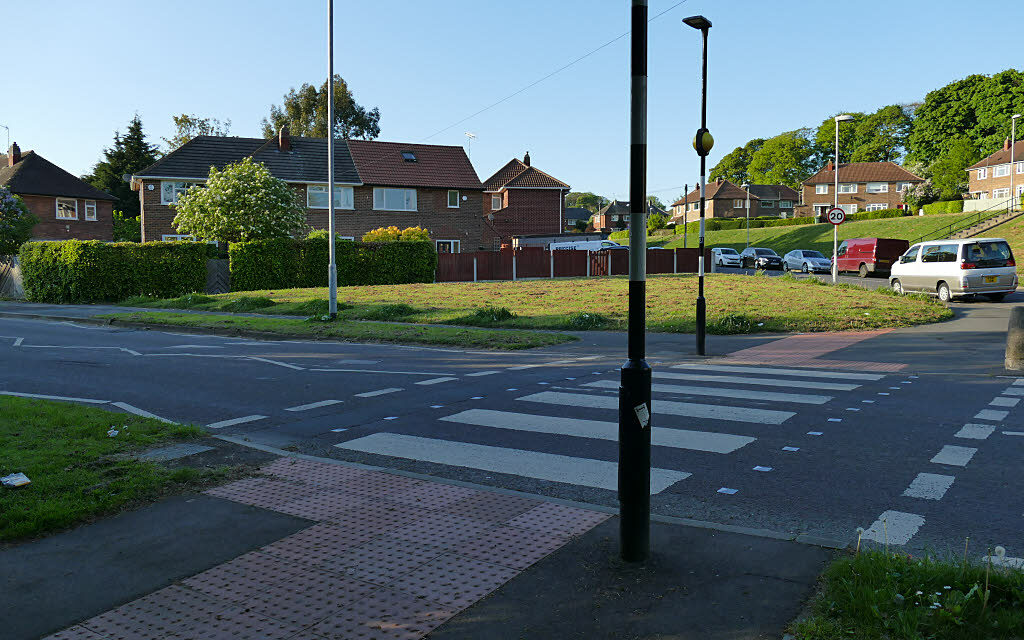
Seen a gap beside a zebra or light-controlled crossing and tempted to use it for a quick drop-off? Do not. The white zig-zag lines are a protected part of the crossing, not a short-stay parking space.
The plain-English answer to ‘can you park on zig-zag lines?’ is no. Highway Code Rule 191 says drivers must not park on a crossing or in the area covered by its zig-zag lines. The rule is about protecting the view between drivers and people who may be about to cross, particularly children, people using a wheelchair and anyone stepping out from behind a vehicle.
What the zig-zags mean
At a zebra, pelican, puffin or similar pedestrian crossing, the zig-zag markings lead up to the crossing and continue away from it. They tell drivers that this is not an ordinary stretch of kerb. A parked car can hide a waiting pedestrian from an approaching driver, or hide an approaching vehicle from someone preparing to cross.
That is why the restriction is stricter than a single yellow line. It does not turn on the time of day, the length of the errand or whether you leave the engine running. A school-run stop, a delivery, collecting a passenger and waiting for someone to come out are all bad reasons to use this space.
Parking, stopping and being held in traffic are different
A driver who has to stop because traffic ahead has stopped is not choosing to park. Even then, the better decision is made before the crossing: do not enter unless there is room to clear it. Rule 192 says that crossings should be kept completely clear in slow-moving or queuing traffic, and that drivers should not enter one if they cannot clear it.
So, if a queue reaches the zig-zags, wait behind them. It may feel over-cautious when the lights are green, but it keeps the crossing visible and avoids blocking people who have the right to use it.
Does a Blue Badge, hazard lights or a passenger make an exception?
No. A Blue Badge can give concessions in some parking situations, but it does not override a prohibition at a pedestrian crossing. Hazard warning lights are not permission to stop either. Nor does it matter that a passenger is only getting in or out: the problem is the obstruction created during that stop.
If a passenger needs close access, look for a legal bay or a safe side street well clear of the crossing. A few extra metres of walking is preferable to removing the sight line that the road markings are designed to preserve.
Do not confuse crossing zig-zags with school entrance markings
Yellow zig-zag markings outside a school are not the same visual treatment as the white zig-zags at a zebra or signal-controlled crossing. They are still not an invitation to stop. The Highway Code’s parking guidance says not to stop or park on school entrance markings when an upright sign shows a prohibition of stopping.
Read the sign at the school gate carefully. It sets the days and times that apply, and some restrictions cover much of the school day rather than just the busiest few minutes. The key distinction is simple: crossing zig-zags are part of a crossing rule, while school markings need the nearby sign to tell you the local restriction.
What about a zebra crossing with a central island?
Treat it with extra care. The Highway Code explains that a zebra crossing with a central island is two separate crossings. Do not assume the island makes the approach markings less important, or that a pedestrian has finished crossing simply because they have reached it. Watch both sides of the road and keep the marked approaches clear.
Could you be penalised?
Parking where the Highway Code says you must not can lead to enforcement. More importantly, it creates a real safety risk at the point where a pedestrian and a vehicle are most likely to conflict. Do not make the calculation based on whether an enforcement officer is nearby. Make it based on whether a child or another road user can be seen in time.
A quick crossing checklist
- White zig-zags at a pedestrian crossing: do not park or use them for a quick pick-up or drop-off.
- Queue ahead: wait before the markings if there is any chance you will block the crossing.
- Yellow school zig-zags: check the upright sign and do not stop during the stated prohibition.
- Need to stop: find a legal place far enough away that people and approaching traffic can see each other.
The safest habit is also the easiest one: treat every set of crossing zig-zags as a no-go area for parking, whatever the time pressure.