If your electric car stops, the first job is the same as with any breakdown: get yourself and your passengers somewhere safe, make the car as visible as possible and call for help. The recovery method is where an EV can be different.
Do not assume that selecting neutral means it can be pulled away on a rope or with all four wheels on the road. The recovery instructions for an EV are model-specific, and getting them wrong can damage the drive system or leave a recovery crew dealing with a car that will not release its parking brake.
Tell the recovery operator it is an EV before they arrive
When you call, give the make, model and registration, say that it is fully electric and describe exactly what has happened. Mention whether it has been in a collision, floodwater or a fire, whether there is any warning about the high-voltage system, and whether the wheels can turn.
That information helps the operator bring the right equipment rather than treating the car as an ordinary non-runner. A low-voltage 12V issue, a flat traction battery, a tyre problem and high-voltage damage can all leave an EV apparently stranded, but they do not call for the same response.
If the car has been in a serious impact or has smoke, heat, a sharp chemical smell, hissing or popping noises, keep people well away from it and call 999. Do not reconnect a charger, open up the battery area or try to move the car yourself.
Why flat towing is usually the wrong move
Many electric cars should not be towed with their driven wheels turning on the road. Depending on the design, turning those wheels can rotate the electric motor and may damage electrical or drivetrain components. An electronic parking brake or parking pawl can also make a seemingly simple pull a bad idea.
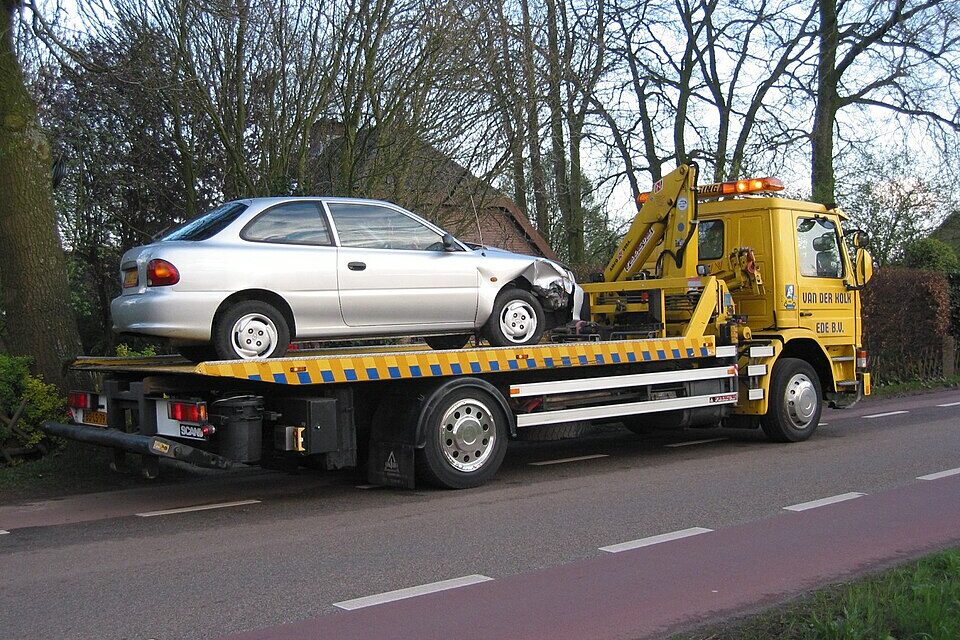
That does not mean every EV must always be carried in exactly the same way. It means the recovery operator should follow the instructions for that exact vehicle. A flatbed is often the cleanest answer, while a manufacturer-approved wheel-lift or dollies may be suitable in some cases. Check the vehicle handbook if it is safe to do so, but do not try to interpret it while stranded in a live lane.
The useful rule for a driver is simple: do not agree to a rope tow or a wheels-on-the-ground tow just because the car appears to roll. Ask the recovery provider to confirm the approved method for your make and model.
A flat traction battery is not the only possibility
An EV can be unable to start or select drive even when its large traction battery still has charge. Like most cars, it has a separate 12V battery that powers control systems. If that battery is flat or faulty, the car may not wake up, unlock normally or release its electronic systems.
That is a job for the vehicle’s approved procedure or a trained recovery technician, not a reason to improvise around orange high-voltage cables. Never touch, cut or disconnect orange cables or parts marked as high voltage. They are not a substitute for normal 12V jump-start terminals.
If your display says there is no usable driving range left, resist the temptation to keep trying to move the car. Repeated attempts can make recovery harder. Explain the remaining range, charging warning and location to the provider. Some services can provide a limited roadside charge, but availability and suitability vary, so a flatbed may still be the sensible plan.
What to do while you wait
- Put people first. Leave the vehicle from the safest side if you can and stand behind a barrier where one is available. On a motorway or high-speed road, follow the usual breakdown advice and contact the emergency services if there is immediate danger.
- Do not plug it in. A damaged, flooded or smoking EV should not be connected to a chargepoint.
- Do not crawl underneath. The battery pack is commonly mounted low in the floor. A scrape, impact or water exposure is a reason to let a professional assess it.
- Keep the key or phone key available. Recovery crews may need it to follow the manufacturer procedure, but do not leave it in an unattended car.
- Take a few clear photographs if it is safe. Capture warning messages, visible damage, the road position and any contact with water. That can help the recovery company, a garage and an insurer.
After a collision or flood, be more cautious
A minor puncture with no other damage is one thing. An EV that has struck the underside, been in deep water or involved in a collision needs more care. Battery damage is not always obvious from the outside, and the car should not be charged until it has been assessed if there is any doubt about the high-voltage system.
The UK government’s recall guidance also makes the safety point clearly: if a manufacturer says a vehicle has a serious safety defect, it should not be driven. You can check a car for outstanding safety recalls using its registration, which is worth doing after buying any used EV as well as during normal ownership.
Check your breakdown cover before the emergency
Do not assume every policy handles EVs in the same way. Before renewal, ask whether the provider will recover your exact vehicle, what it does if the traction battery is flat, whether it offers roadside charging and where it will take the car. Also check whether onward travel or a courtesy vehicle is included if a specialist repairer is needed.
This is not only an EV-owner issue. Anyone buying a used electric car should find the towing and recovery section of the handbook before the first long trip, save the recovery number and make sure the provider knows the model. That five-minute check is much easier than debating a rope tow on a wet hard shoulder.
The bottom line
An electric car that has broken down should be recovered according to its own manufacturer instructions, not a one-size-fits-all towing rule. Tell the provider it is an EV, describe any impact, water or high-voltage warning, keep clear of damaged electrical equipment and let the recovery crew arrange the approved method. For many situations, that will mean carrying it rather than dragging it.