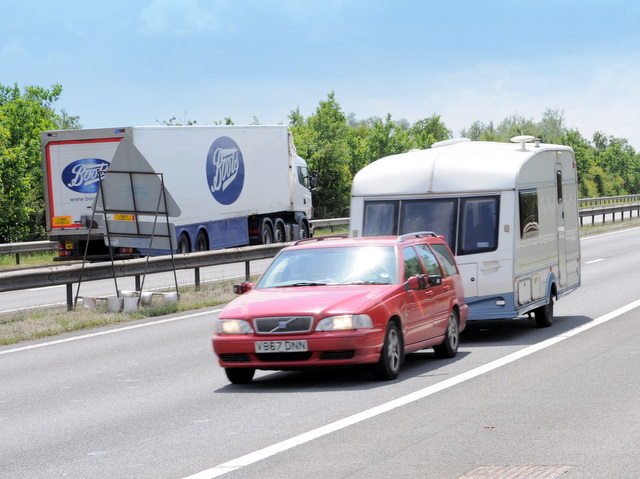
Electric cars can make relaxed tow vehicles: instant torque is useful when pulling away and their low-mounted batteries can help stability. But the answer to whether an EV can tow a caravan, trailer or horsebox is never simply ‘yes, it has plenty of power’. It depends on the exact car, its approved limits and the weight you intend to pull.
The most useful rule is simple: if the manufacturer does not give your exact EV a towing limit, do not assume a towbar makes towing legal or safe. A fitted hitch is not evidence that the car has been approved to tow.
First, establish whether your exact EV is allowed to tow
Start with the handbook and the manufacturer’s plate, usually found in a door opening, under the bonnet or in the handbook. The key figures are the maximum permitted mass of the car and the maximum permitted mass of the car and trailer together. The difference can indicate the maximum braked-trailer weight, but the handbook remains the authority because manufacturers may set more specific limits.
Look for these details before comparing towbars or caravans:
- the maximum braked trailer weight
- the maximum unbraked trailer weight
- the permitted towball noseweight
- any conditions, such as a particular wheel size, trim, battery, drivetrain or factory towing pack
- whether the car is explicitly listed as having no towing capacity
Do not borrow a figure from a similar-looking model. Battery size, motor layout, model year and even the fitted equipment can change the approved limit. A capable SUV shape does not prove anything.
A towbar fitter should confirm compatibility, not create it
A good fitter will match the towbar and electrics to the vehicle and check the manufacturer’s instructions. Ask them plainly whether your exact registration or VIN is approved for towing, what it may tow, and whether the fitting affects parking sensors, rear cross-traffic systems or a warranty. Keep the invoice and paperwork.
Be especially cautious with an EV that has no published towing limit. Retrofitting a towbar for a bike carrier is not the same as approving the vehicle to pull a trailer. Towbar-mounted cycle carriers also have weight limits, including the weight of the rack itself and the vertical load permitted on the towball.
Work out the real weight, not the optimistic advert weight
A caravan’s brochure weight is not necessarily the weight you will tow on holiday. Add passengers, luggage, water, bikes, a battery, gas bottles and accessories to the car and trailer as applicable. The combined limit includes the car, people, cargo and fuel.
The DVSA says the vehicle manufacturer’s plate and handbook are where to find the relevant limits. For an unbraked trailer, the loaded trailer must not exceed 750kg and should not exceed half the car’s weight. For a braked trailer, the loaded car-and-trailer combination must stay within the applicable plated limit.
The towball noseweight matters too. It must be within both the car’s and trailer’s limits. Loading heavy kit at the very back of a caravan can reduce noseweight and make the outfit less stable. Do not try to fix a poor load balance by exceeding the EV’s permitted vertical load.
Your licence still matters
The vehicle may be capable of towing while the driver is not licensed for the combination they have chosen. GOV.UK says drivers who got a car licence from 1 January 1997 can tow a trailer up to 3,500kg maximum authorised mass, subject to the licence category and the limits of the vehicle and trailer. Older licences can have different entitlements. Check the categories on your driving record rather than relying on an old rule of thumb.
A towing limit is not a target. It is the ceiling. If you are new to caravans or trailers, towing training is a better investment than trying to learn with a fully loaded outfit on the first holiday Friday.
Plan charging around the trailer, not the dashboard estimate
Towing increases energy use because the car has to move extra weight and, often more importantly, push a taller, less aerodynamic shape through the air. Expect range to fall and leave a generous margin. There is no honest universal percentage because speed, weather, terrain, trailer shape and load all matter.
Plan shorter legs than you would when solo and check charging sites in advance. A charge point that is easy to enter in an unhitched hatchback may be awkward with a caravan behind it. Drive-through bays are ideal, but they are not available everywhere. Decide before you set off where it is safe and practical to park or unhitch if necessary.
Use the car’s towing mode if it has one. It can adjust stability, braking regeneration, rear sensors and driver-assistance systems, but it does not increase the approved towing weight.
Pre-departure checks that matter
Before every trip, check the basics rather than trusting yesterday’s setup:
- Confirm the trailer is correctly coupled and the breakaway cable or secondary coupling is attached as the manufacturer specifies.
- Check trailer lights, indicators and the electrical plug.
- Check car and trailer tyre condition and pressures for the loaded journey. The legal minimum tread depth is 1.6mm across the central three-quarters of the tread around its full circumference, but do not treat that as an ideal target for a long loaded trip.
- Make sure the load is secure and distributed sensibly.
- Check that the number plate and lights are visible, and that mirrors give an adequate rearward view.
- Recheck the route, height restrictions and charging stops.
The DVSA warns that an insecure or dangerous towing setup can lead to a fine, penalty points and a driving ban. On the road, leave more space, brake earlier and ease off smoothly if a trailer begins to snake. Do not brake hard through a bend.
The practical verdict
An electric car can be an excellent tow car when the exact vehicle is rated for the job and the journey is planned around its real-world towing range. The expensive mistake is buying a towbar, caravan or EV on the assumption that torque alone settles the question. Check the plate, handbook, weights, licence and charging plan first, then choose the equipment.
For the underlying UK rules, see the official GOV.UK guidance on what you can tow and the DVSA’s car and trailer safety checks.