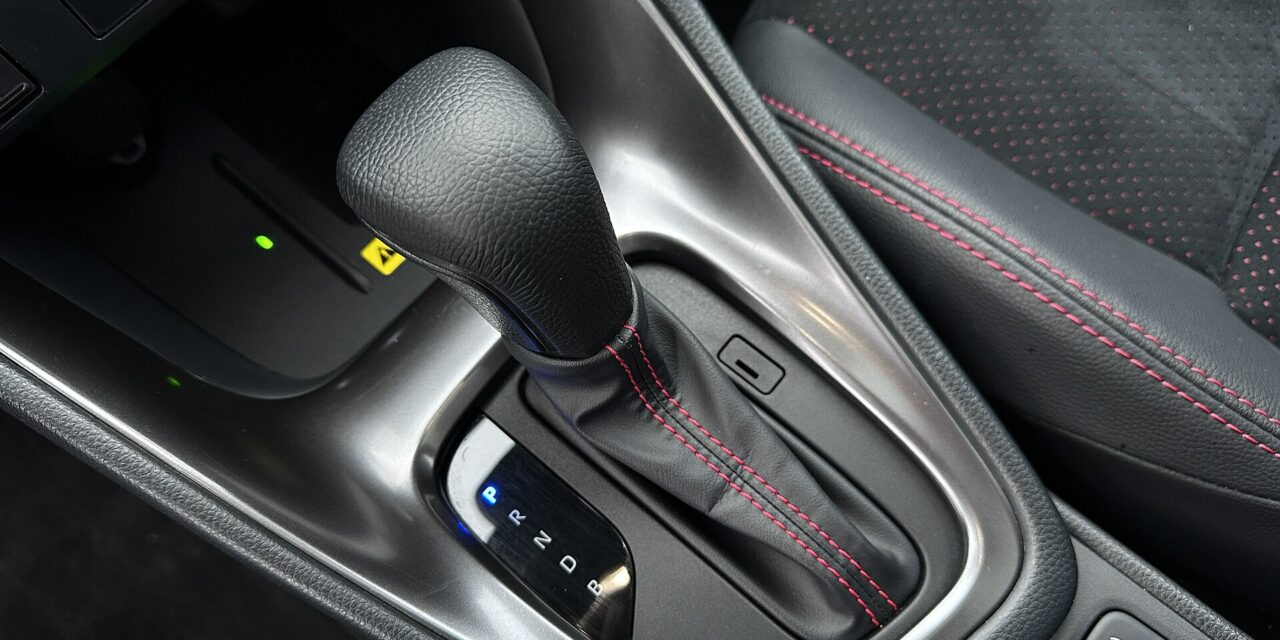
If you have just moved to an automatic car, the letters beside the selector can look simpler than they really are. P, R, N and D cover the normal jobs. The extra buttons or positions, often S, B, L or + and -, are where one model can differ sharply from another.
The useful rule is simple: know the four core positions, use the brake whenever you select a direction, and treat the handbook as the final word on the extra modes in your own car.
The short answer
- P is Park. It locks the transmission for parking.
- R is Reverse. It makes the car move backwards.
- N is Neutral. The engine is disconnected from the driven wheels.
- D is Drive. The car selects forward gears automatically.
Most automatic cars require the foot brake to be pressed before you can move out of P, and many will not start unless P or N is selected. That is a useful safeguard, not a reason to rush the selection. Keep your foot firmly on the brake, check around the car and choose the direction only when you are ready to move.
P for Park: what it does and what it does not do
Park engages a mechanical lock inside the transmission. It is the position to select once the car is stationary and you are parking up. It is not a substitute for securing the car with its parking brake.
Apply the parking brake as well, especially on a slope. The Highway Code’s parking-on-hills guidance specifically says to apply the handbrake firmly and use Park in an automatic. It also advises turning the steering wheel appropriately for the direction of the hill.
Do not select P while the car is still rolling. Stop completely, keep the foot brake applied, select P and then secure the car. On a steep hill, applying the parking brake before releasing the foot brake helps avoid leaving the transmission taking the vehicle’s weight.
R for Reverse: slow, deliberate and with a full check around
Reverse is for moving backwards only. Select it only when stationary and with the foot brake held. Cameras and sensors are helpful, but they are not a replacement for looking properly around the car, including checking mirrors and blind spots. Small children, cyclists and low objects can be missed by parking aids.
If you are manoeuvring in a tight space, use the car’s natural creep carefully. Many conventional automatics will inch forward or backward when a direction is selected and the brake is released. That is useful at walking pace, but it means there is no need to add accelerator immediately.
N for Neutral: not a downhill shortcut
Neutral disconnects drive to the wheels. It can be useful in a car wash if the operator asks you to leave the vehicle in neutral, or during certain recovery procedures when the vehicle maker says it is appropriate. It is not the position to use while travelling downhill or when waiting at ordinary junctions.
The Highway Code warns against coasting, which includes travelling in neutral. You lose engine braking, the car can gather speed quickly downhill and steering response may be affected. Keep the car in D unless a genuine, vehicle-specific situation calls for N.
Do not assume that neutral makes every automatic safe to tow either. Some gearboxes and hybrid systems have strict recovery instructions. If the car cannot be driven, follow the handbook or recovery operator’s instructions.
D for Drive: the normal forward setting
D is the everyday position for moving forward. The gearbox chooses gears based on speed, throttle input, gradient and, on many newer cars, the driving mode selected. For ordinary town, motorway and country-road driving, leave it in D and concentrate on observation, speed and smooth control.
At a short stop, such as a queue that is still moving, keep the car in D with the foot brake applied. If you expect to be stopped for longer, follow the car maker’s advice. Many cars have auto-hold, an electronic parking brake or stop-start systems that change the routine. Never rely on creep to hold the car on a hill.
What S, B, L and M usually mean
These letters are not as universal as P, R, N and D. A symbol or name can mean something slightly different between makes, engines and hybrid systems, so use the handbook for the final answer. The usual meanings are:
S for Sport
Sport normally makes the gearbox hold lower gears longer and react more quickly to accelerator input. It can make the car feel more responsive for overtaking or a hilly road, but it usually raises engine speed and fuel use. It is not a setting you need for routine driving.
B for Brake
B is common on hybrids and some electric cars. It increases regenerative braking or engine braking when you lift off the accelerator, which can be useful on a long descent. It is not normally a replacement for the foot brake, and the amount of deceleration varies widely by car and battery state.
L, 1 or 2 for lower gears
A low-range position limits the gearbox to lower gears. It can give more engine braking on a steep descent or prevent repeated gear changes while towing, if the handbook permits it. It is not for normal high-speed driving.
M, + and – for manual control
Manual mode lets the driver request upshifts and downshifts, often using the selector or steering-wheel paddles. The gearbox will usually still protect itself from an unsafe change. Use it when you want to hold a lower gear on a descent or prepare for an overtake, not as a test of how late you can change gear.
Five automatic-car habits worth getting right
- Use one foot. In a UK automatic, use your right foot for both brake and accelerator. Rest the left foot away from the pedals.
- Brake before selecting a direction. Come to a complete stop before switching between D and R.
- Do not coast in N. Keep engine braking and proper control available.
- Use the parking brake as well as P. This matters particularly on a hill.
- Learn your own selector before driving away. A rotary dial, push buttons, a stalk and a conventional lever can all work differently. Spend two minutes with the handbook rather than guessing at a junction.
The bottom line
P, R, N and D are the same basic language in almost every automatic car: park, reverse, neutral and drive. The safest approach is to use D for normal forward driving, R only when stationary and ready to reverse, N only when there is a specific reason, and P with the parking brake when you leave the car. For every other letter, check the handbook before relying on it.