If you are buying a used car in the UK, a recall check is one of the fastest ways to avoid inheriting somebody else’s safety problem. It takes minutes, costs nothing on GOV.UK and can tell you whether a car has an outstanding safety recall that has still not been dealt with.
That matters more than many buyers realise. A used car can look tidy, drive well on a short test route and still have a manufacturer recall hanging over it for something serious. In the worst cases, GOV.UK says you must not drive a vehicle with a serious safety defect until the manufacturer has told you what to do.
Why a recall check deserves a place on every used-car shortlist
When people talk about checking a used car, they usually think about mileage, MOT history, service stamps and finance. All of those matter, but a recall check deserves equal attention because it answers a very simple question: has the manufacturer flagged this vehicle for a safety-related problem, and has it actually been fixed?
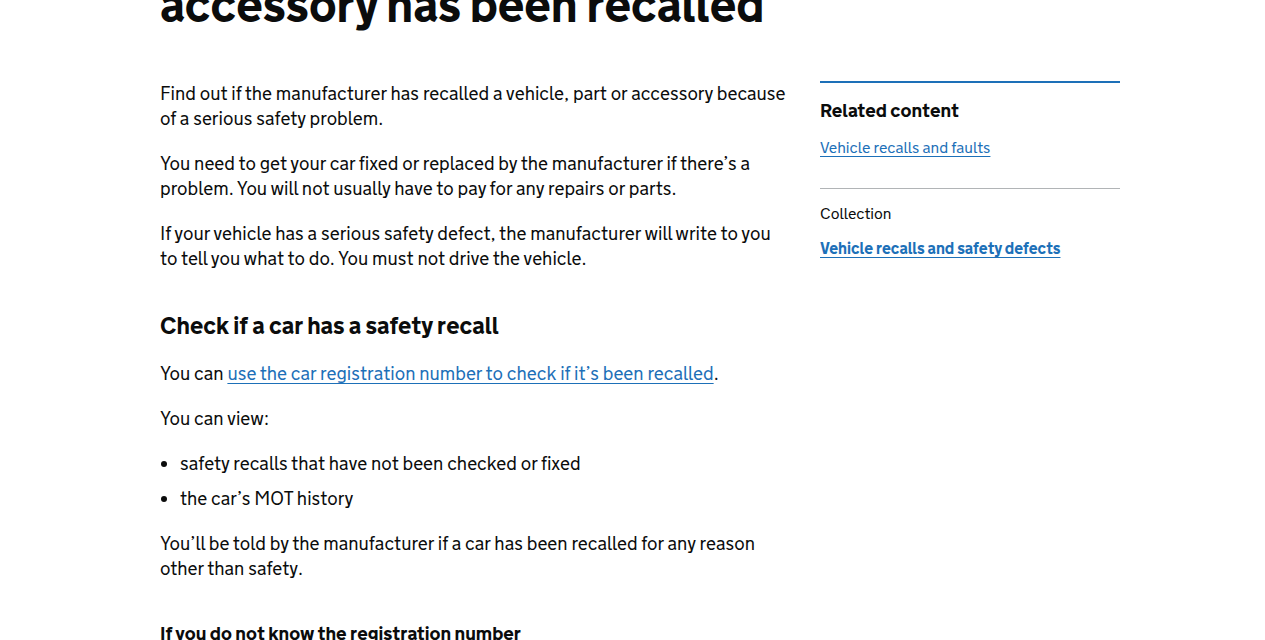
According to GOV.UK, you can use a car’s registration number to check for safety recalls that have not been checked or fixed. The same service also links to the car’s MOT history. That makes it useful before you travel, before you leave a deposit and definitely before you pay in full.
A recall is not automatically a reason to walk away from a car. Plenty are resolved quickly and at no cost to the owner. The danger is buying first and discovering later that the recall is still outstanding, the seller never bothered to book it in or the manufacturer has issued a more urgent instruction than the advert let on.
The official UK recall check to use first
Start with the GOV.UK vehicle recall page. It lets you:
- check a car by registration number
- check a car even if you do not know the registration number, using the make, model and year
- look for other vehicle types and recalled parts or accessories
- see whether there are safety recalls that have not been checked or fixed
That is the key point. The official service is aimed at unresolved safety recalls, not general wear and tear, and not every non-safety campaign a manufacturer may run quietly in the background.
GOV.UK also makes clear that if a car has been recalled for a reason other than safety, the manufacturer will tell the keeper directly. So if you are buying used, do not assume a clean result means the car has never had any manufacturer action at all. It means there is no unresolved safety recall showing through that route.
What the result really tells you
There are three broad outcomes.
1. No outstanding safety recall showing
This is the result buyers want, but it is not a substitute for the rest of your checks. You should still look at the MOT history, the V5C and logbook details, service history and whether the seller’s story makes sense.
2. An outstanding recall is showing
This does not automatically kill the deal, but it changes the conversation immediately. You now need to know:
- what the recall relates to
- whether the manufacturer has parts and an active fix available
- whether the car is still safe to drive in the meantime
- whether the seller will get it completed before sale
- whether there is written proof once the work is done
If the seller brushes this off with something like “it is only a minor update”, take that as a warning sign until they prove otherwise.
3. You cannot get a clean answer from the registration-based check
If you do not know the registration, or the result is unclear, GOV.UK also offers a route to check by make, model and year. That is useful when you are researching a shortlist before contacting sellers. Once you are serious about a specific car, you should still check the exact registration and ideally confirm with the manufacturer using the VIN if possible.
Do recalls show up on MOT history?
Sometimes, yes, but do not rely on MOT history alone.
GOV.UK says a vehicle’s MOT history may also tell you if it has been recalled for a safety reason, depending on the manufacturer. That means the MOT history checker is a good supporting tool, not your only one.
If you already use MOT history to spot repeat advisories, suspicious mileage patterns or rushed pre-sale passes, keep doing that. Just add a recall search to the same routine. They answer different questions.
- MOT history shows how the car has fared at test time over the years
- a recall check shows whether the manufacturer has flagged an unresolved safety issue
Together they give you a much clearer picture than either one on its own.
What if the car has a fault, but not a safety recall?
This is where buyers sometimes get caught out.
GOV.UK separates safety recalls from other registered faults. It says faults in the way vehicles, parts and accessories are designed or made have to be registered with DVSA if they could make the item unsafe in future or mean it no longer meets the legal standard. GOV.UK also says you can contact the manufacturer or dealer to check for any registered faults.
That matters because a car can have manufacturer-related issues that are not presented to you in the same way as an active safety recall. So if you are buying a model with a known reputation for a certain problem, it is sensible to ask a franchised dealer to check the VIN for outstanding recalls and any relevant campaigns or registered faults.
The questions to ask before you leave a deposit
Once you have identified a car you like, ask these questions plainly and in writing if possible:
- Has this car ever had an outstanding safety recall?
- If yes, has the work been completed?
- Can you show an invoice, recall completion note or dealer confirmation?
- Can I have the VIN so I can confirm with the manufacturer if needed?
- If there is an active recall now, will you get it fixed before handover?
A decent dealer should not be offended by any of that. A private seller might not have the paperwork to hand, but should at least be willing to cooperate if nothing is being hidden.
Who pays for recall work?
Usually, the manufacturer.
GOV.UK says you will not usually have to pay for repairs or parts when there is a recall issue, and it also says owners usually do not have to pay to get registered faults fixed. That is good news, but it does not mean there is no inconvenience. You may still face booking delays, parts shortages or the hassle of chasing a dealer after you have bought the car.
That is why it is better to sort this before purchase, not after.
When a recall should make you slow down or walk away
Be more cautious if any of the following apply:
- the seller did not mention an outstanding recall and only admits it when asked
- they cannot provide any proof that recall work has been completed
- the car is being pushed for a quick sale before you have time to verify it
- the recall sits alongside patchy service history, repeated MOT issues or a vague ownership story
- the seller refuses to share the VIN or says you do not need to check with the manufacturer
A recall on its own is often manageable. A recall plus evasive behaviour is different.
If the recall is outstanding, should you still buy the car?
Sometimes yes, but only on your terms.
The safest route is simple: make the seller get the recall work done before you collect the car, then ask for proof. If it is a dealer sale, that is a reasonable expectation. If it is a private sale, you need to decide whether the price, risk and hassle still stack up.
If you are tempted to buy anyway, do not just rely on a promise that “it is booked in”. Ask where, when and for what. If the manufacturer or franchised dealer can confirm the recall and appointment, that is far better than taking the seller’s word for it.
And if GOV.UK or the manufacturer indicates the defect is serious enough that the vehicle should not be driven, do not treat that as a negotiable point.
The best way to use a recall check in a full used-car process
A sensible UK used-car routine looks like this:
- run the recall check on GOV.UK
- check the MOT history for patterns and advisories
- confirm the V5C details match the car and the seller
- check service history and any major invoices
- check for outstanding finance or insurance write-off history through a provenance check if the value justifies it
- inspect the car properly and test drive it
- ask for the VIN if anything needs confirming with the manufacturer
None of those steps is complicated on its own. The mistake is skipping one because the advert looks convincing.
The bottom line
A recall check is one of the easiest free checks UK buyers can run, and it can stop a cheap-looking used car becoming an expensive or unsafe mistake.
Use the official GOV.UK tool first. If anything looks unclear, follow up with MOT history and a manufacturer VIN check before money changes hands. The best used-car buys are rarely the ones that need the most explaining.
Quick answers buyers often want
Can I buy a used car with an outstanding recall?
Yes, but you should understand exactly what the recall is for and ideally have the seller get it fixed before handover.
Do I have to pay for recall repairs?
Usually no. GOV.UK says you will not usually have to pay for repairs or parts linked to a recall.
Does a clean MOT mean there is no recall?
No. MOT history may show a safety recall depending on the manufacturer, but it is not a guaranteed substitute for the official recall check.
Can I check recalls without the number plate?
Yes. GOV.UK provides a route to check a car without the registration number if you know the make, model and year.