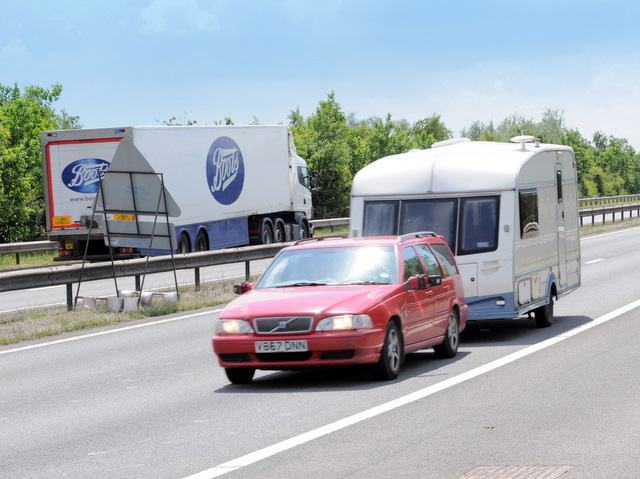
Reaching 70 does not automatically mean handing over the caravan keys. For most people towing a caravan behind a normal car, the important job is to renew the licence on time and check what categories are actually shown on the DVLA record. The trap is assuming that an old paper licence, an old entitlement or the car’s towing limit tells the whole story.
The short version is this: a standard car licence must be renewed at 70 and then every three years. Whether a particular car and caravan combination is legal still depends on the licence entitlement, the combination’s maximum authorised mass, the car manufacturer’s limits and the equipment. Do those checks before booking a ferry, a campsite or a long motorway run.
Start with the renewal, not the caravan
In Great Britain, a car or motorcycle licence expires at 70. DVLA says you can renew online for free from 90 days before your 70th birthday, or use the postal route if that suits you better. After 70, the renewal is due every three years.
Do not leave this to the week before a holiday. DVLA says a driver can usually continue driving while an application is being processed only if specific conditions are met, including having held a valid licence, having a doctor’s support to continue driving and driving only under the previous licence conditions. A medical issue or an expired entitlement can make the position less straightforward.
If you have a condition that could affect safe driving, check it rather than guessing. DVLA requires drivers to report some relevant medical conditions, and says failure to do so can lead to a fine of up to £1,000.
The licence category is the first towing check
Use the DVLA’s online driving-licence service to look at the live record. That is more useful than relying on an old photocard, especially if it has recently been renewed or replaced.
For car-and-caravan towing, the useful numbers are set out in GOV.UK’s towing guidance:
- Licence issued before 1 January 1997: you can usually drive a vehicle-and-trailer combination up to 8,250kg maximum authorised mass, but DVLA says to check the individual licence record.
- Licence issued from 1 January 1997: you can tow a trailer up to 3,500kg maximum authorised mass under category BE. If BE is not printed on the physical licence, DVLA says it will be added when the licence is next renewed.
- Heavier combinations: these are not a case for optimism or a rough calculation. DVLA says that towing beyond the allowance can require a provisional C1+E entitlement, the lorry theory test and a C1+E driving test.
Maximum authorised mass, often shortened to MAM, is the permitted maximum loaded weight. It is not necessarily what the car or caravan weighs on the day. You can normally find it in the handbook and on a plate or sticker on the vehicle or trailer. This is why an apparently light caravan is not enough information by itself.
Do not confuse licence entitlement with the car’s limit
A licence can permit a combination that the particular car should not tow. The car’s handbook or manufacturer data will state its braked towing limit, noseweight limit and gross train weight. The caravan’s plate supplies its own MAM. All of those limits matter.
Before committing to a caravan, ask the seller for a clear photo of its weight plate and compare it with the exact car’s handbook. Check the car’s registration, engine and gearbox, not just the model name. Towing limits can vary between versions of the same car, and an optional towbar does not raise the manufacturer’s rating.
The same principle applies to loading. Bikes, awnings, batteries, water and luggage can turn an easy-looking outfit into a poor or illegal one. Keep the heavy items low and near the axle, respect every individual limit and use a public weighbridge if there is any doubt.
Three questions to ask before you set off
- Is the licence current? Check the renewal date and the categories on the DVLA record. If you are approaching 70, renew early rather than assuming the old entitlement will take care of itself.
- Is this exact outfit within every weight limit? Check the driving entitlement, the car’s towing capacity, gross train weight, the caravan MAM and the towbar’s noseweight limit. One favourable figure does not cancel another.
- Is the caravan ready for the road? Check tyres, lights, brakes, breakaway cable, coupling, mirrors, number plate and load security. If you have not towed for a while, a refresher course is a sensible purchase, not an admission of defeat.
Insurance is a separate conversation
Being legal to tow does not automatically mean every loss is covered in every circumstance. Read the car policy and caravan policy before travel, paying particular attention to the permitted driver, trailer cover, breakdown cover, European travel if relevant and any security requirements when the caravan is stored. If the tow car has been modified with a towbar or other equipment that the insurer asks to be declared, do that before departure.
For a borrowed caravan, agree in writing who insures the caravan and its contents. For a borrowed tow car, make sure the driver is actually insured to drive it. Those are simple calls to make at home and awkward problems to discover at the roadside.
Will you need a medical or a paper application?
Many drivers can renew their ordinary car licence online, but not every entitlement follows the same route. GOV.UK specifically says that C1 and D1 entitlements cannot be renewed through the standard online over-70 service and must be renewed by post. This matters most to people who also drive heavier vehicles or minibuses, but it is a good reason to inspect the licence record rather than assuming every historic category is unchanged.
Medical declarations and eyesight are part of the renewal process. The legal eyesight standard is only a floor, not a towing assessment. If night driving, glare, reversing or judging a long outfit feels harder than it did, book an eyesight test and consider towing training before the season begins.
The practical bottom line
Age 70 is a licence-renewal milestone, not a blanket ban on towing a caravan. The sensible sequence is: renew the licence, view the live DVLA categories, check the car and caravan plates, then check insurance and roadworthiness. That is more reliable than trusting an old entitlement, a dealer’s reassurance or a figure from an internet forum.
If the numbers are close, or the combination is heavier than a conventional family car and caravan, get professional advice before towing. A few minutes spent checking the record and weights is cheaper than discovering a problem when you are already packed for a trip.